
 Operion Journal
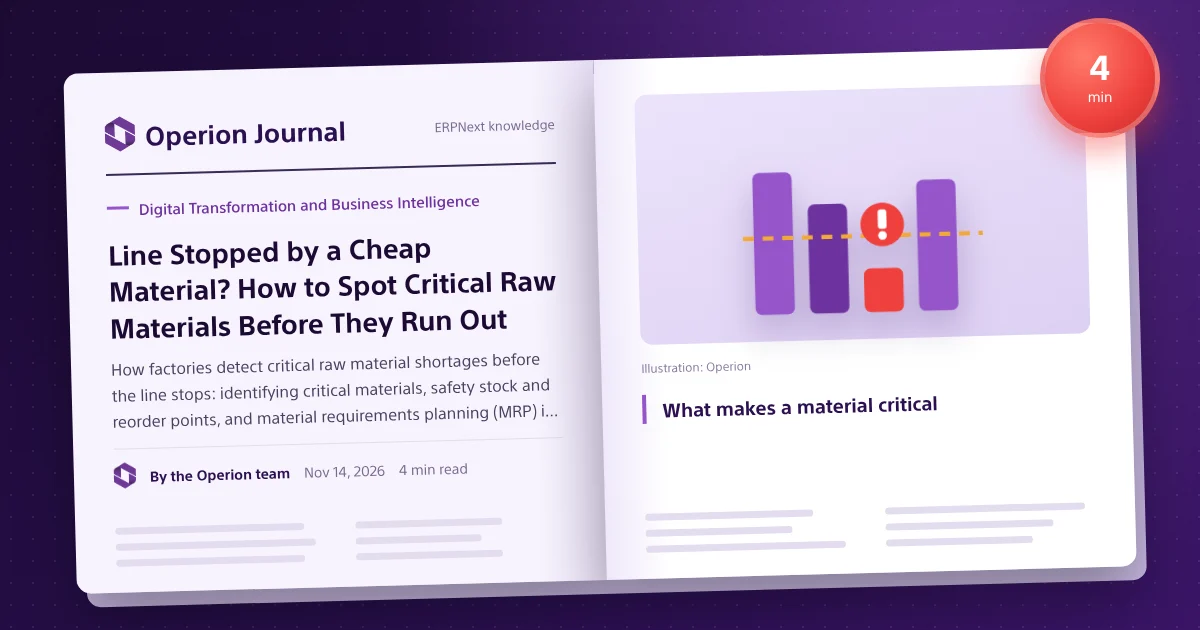
The line runs at full speed with confirmed orders, then stops because a packaging item, an adhesive or a small part ran out: a fraction of product cost that halts a whole line. Factories watch expensive materials closely and leave cheap ones to general follow-up, but importance is the impact of absence, not price. Here is how to identify critical raw materials and build an early warning in your ERP.
What makes a material critical
- Production stops without it.
- Long lead time.
- A single supplier.
- Irregular consumption.
- Storage limits such as short shelf life.
Step 1: classify materials
| Class | Description | Follow-up |
|---|---|---|
| Critical, high value | Costly and stops production | Precise planning, weekly review, backup supplier |
| Critical, low value | Cheap but stops production | Generous safety stock, automatic reorder |
| Non-critical, high value | Costly with alternatives | Lean stock for cash |
| Non-critical, low value | Limited impact | Simple reorder |
Cheap critical materials cause the most surprise stoppages; extra safety stock costs little compared with a stopped line.
Step 2: safety stock and reorder point
Reorder point = average daily use × lead time in days + safety stock. Illustrative example: 40 units a day, 15-day lead time, 200 safety stock gives 800; order at 800, not near zero.
Step 3: let the system watch
- Reorder levels per item and warehouse raise material requests automatically; see stock.
- Projected, not just actual, stock: actual + on order − reserved for production and sales.
- Production planning: ERPNext Production Plan calculates raw material needs from sales orders or forecasts and BOMs and raises requests only for shortages; see manufacturing.
- Alerts for critical items and a daily coverage report.
Step 4: follow suppliers
Track open orders for critical items, confirmed dates, past delays, shipping and clearance for imports, and keep a qualified backup supplier where possible.
Days of cover
Projected stock ÷ average daily use. A daily report sorted by days of cover shows in a minute which materials need action.
Common mistakes
- Watching by value, not impact.
- Ignoring reserved and on-order quantities.
- Static reorder levels.
- Late consumption recording.
- No backup supplier.
See best ERP for factories and ERPNext for manufacturing, or request a demo.
Frequently asked questions
What is a critical raw material?
One without which production stops and no timely substitute exists, whatever its price.
How is the reorder point calculated?
Average daily use × lead time + safety stock.
Does ERPNext raise material requests automatically?
Yes, from reorder levels and from production plans for shortages.
Actual vs projected stock?
Projected adds on-order and subtracts reserved quantities.