
 Operion Journal
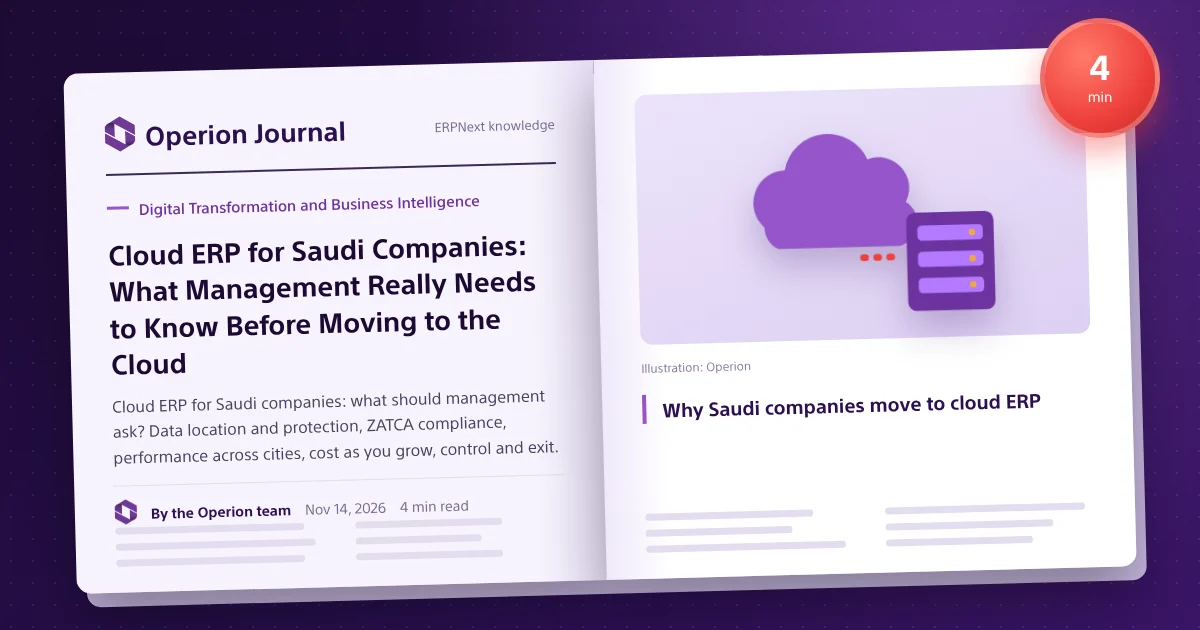
Moving company systems to the cloud is not an IT-only decision. The CEO asks about continuity, the CFO about five-year cost, legal about data location, and operations: will it be as fast in Dammam as in Riyadh? These are fair questions, and answering them turns cloud ERP from a risk into an informed decision. For the general comparison see cloud vs on-premise ERP.
Why Saudi companies move to cloud ERP
- Fast start without buying servers.
- Work from any city without complex private networks.
- Predictable operating cost.
- Continuous updates, including regulatory ones.
- An outage in one office does not stop the company.
Seven questions management should ask
1. Where is our data, and who can access it? With the Personal Data Protection Law and sector rules, ask about hosting region, whether you can choose it, and how server access is logged; check special requirements with legal before signing.
2. Is it ZATCA-compliant? Bilingual QR tax invoices, e-invoicing integration for your wave, VAT reports, and who applies regulatory updates. See VAT with ERPNext.
3. Will it be fast in every branch? Test from your branches before go-live and ask how resources scale. See performance questions.
4. What happens when something breaks? Availability, response times, backup frequency and location, and tested restores.
5. What will it cost after three years of growth? Model five years with expected users and branches. ERPNext has no per-user licences; hosting follows resources.
6. Can we leave? Some subscriptions give only partial exports; ERPNext moves with a full backup.
7. Can we customise? Shared SaaS often restricts it; managed hosting of open source gives an isolated, fully customisable environment.
Shared SaaS or managed hosting?
| Criterion | Shared SaaS | Managed open-source hosting |
|---|---|---|
| Environment | Shared | Isolated |
| Customisation | Often limited | Full |
| Cost | Per user | By resources, no licences |
| Upgrade timing | Provider decides | Agreed with you |
| Exit | Data export | Move the whole system |
Minimum security
- HTTPS always.
- Two-factor authentication.
- Role, branch and document permissions.
- Audit trail.
- Daily backups with tested restores.
- Regular security updates.
Working out five-year cost
| Item | Ask |
|---|---|
| Subscription or licence | Per user? What happens when users double? |
| Hosting and resources | What is included and what does scaling cost? |
| Implementation and integration | Does it include the authority platform and banks? |
| Storage and backup | Limits and overage costs? |
| Support | What is included and what is billed hourly? |
| Exit | Any cost to export data or move the system? |
How IT's role changes
Cloud moves IT from server upkeep to higher-value work: users and permissions, integrations, reporting and managing the hosting provider under the SLA. Without an IT team, these move to the provider and implementer.
Board questions and answers
- "Do we lose control of our data?" Not if you can export it and move the whole system, with tight permissions.
- "What if the provider closes?" Open-source ERPNext moves to another provider or your server.
- "Will cost double as we grow?" Model five years and avoid per-user pricing.
- "Will we stay compliant?" Yes, if the contract assigns clear responsibility for regulatory updates.
Migration plan
- Set non-negotiables: data location, compliance, performance.
- Compare offers in one table.
- Test from every branch.
- Test e-invoicing early.
- Train users on secure access.
- Review performance after a month.
ERPNext in the cloud for Saudi companies
ERPNext runs on managed cloud hosting or your own server, in Arabic and English, with bilingual tax invoices and authority integration through experienced implementers. See ERPNext for Saudi companies or request a demo.
Frequently asked questions
Is cloud ERP safe for Saudi companies?
Yes with encryption, 2FA, permissions, audit trails and tested backups, after reviewing data-location requirements.
Is cloud ERPNext e-invoicing compliant?
Yes, it integrates with the ZATCA platform and issues bilingual QR tax invoices.
SaaS vs managed hosting?
SaaS is shared and per user; managed hosting is isolated and fully customisable.
Can we move to on-premise later?
With ERPNext, yes, with a full backup.
Does cost grow per user?
No licence fees per user; hosting follows resources.