
 Operion Journal
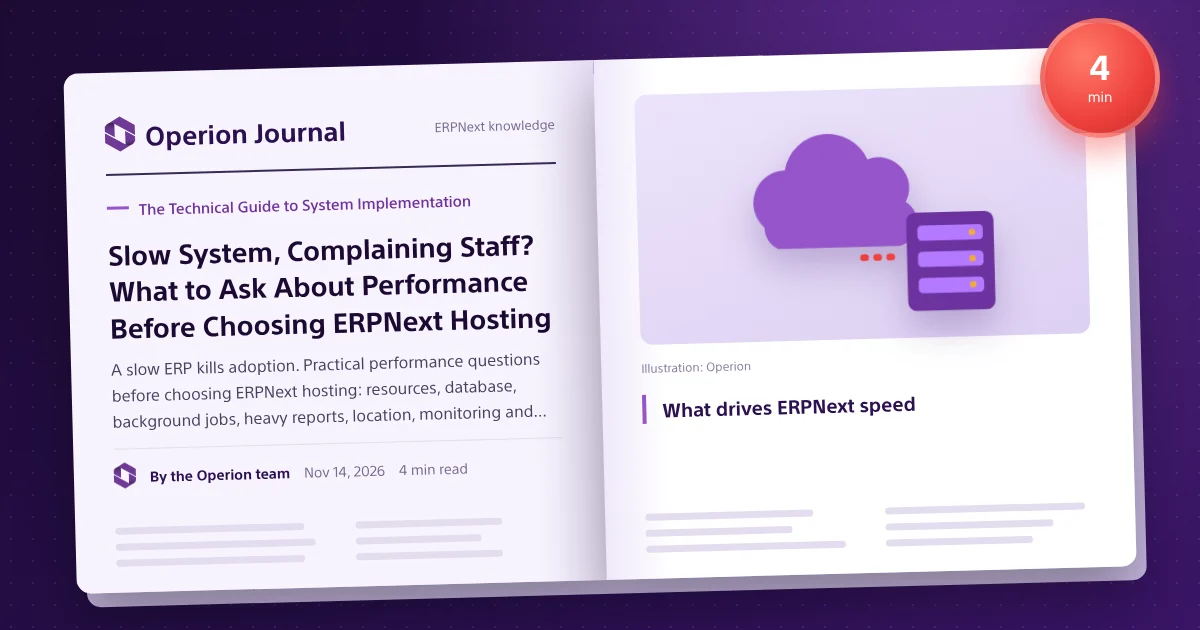
Week one after go-live was fast; six months later invoices take seconds to open, stock reports stall and the remote branch complains every morning. "The system is slow" becomes "the system doesn't fit us". Usually the problem is the hosting environment, not the system. Here are the ERPNext performance questions to ask before choosing or renewing hosting.
What drives ERPNext speed
- Server resources.
- Database size, settings and indexes.
- Background jobs and heavy reports.
- Unoptimised customisations.
- Network distance and quality.
- Version, as newer releases often improve performance.
Questions to ask
- What resources are really ours, dedicated or shared, and how were they sized?
- Can we scale easily, without migration or downtime?
- Where is the server? Pick the region nearest most users, within data-location rules.
- How are background workers managed and monitored?
- How are heavy reports handled: background runs, off-peak schedules, separate analytics such as Insights?
- Is performance monitored, including slow queries and alerts?
- How is the database maintained as logs and tables grow?
- What is the upgrade plan; see ERPNext upgrade benefits.
Signs the problem is hosting
| Sign | Likely cause | Action |
|---|---|---|
| Slow at set times daily | Shared resources or heavy jobs | Move jobs off-peak or add resources |
| Slow in one branch | Network or distance | Test the link, choose a nearer region |
| One screen always slow | Unoptimised customisation or report | Review code or query |
| Late notifications and email | Too few workers | Add and monitor workers |
| Slower month by month | Unmaintained database growth | Clean logs and maintain the database |
Test before you sign
- A trial environment with the proposed resources.
- Your data or similar volume.
- Most-used screens from several branches.
- Your heaviest reports, timed.
- Several users at once.
Frappe Cloud or a private server?
Frappe Cloud is managed hosting from ERPNext's makers with resource plans, regions, monitoring and upgrades; a private server gives full control but needs a team. See cloud vs on-premise and ERPNext on Frappe Cloud. Operion sizes, hosts and monitors through hosting services; talk to us.
Frequently asked questions
Why does ERPNext slow down over time?
Usually database growth without maintenance, insufficient resources, peak-time heavy jobs or unoptimised customisations.
How many resources do I need?
It depends on concurrent users, volume and customisations; size after analysis and test.
Does server location matter?
Yes, distance adds time to every request.
Do upgrades improve performance?
Often, after testing customisations.