 Operion Journal
In the age of digitization and the move to the cloud, data has become the most valuable asset in any organization. It is the complete record of every operation, the basis for decisions, and the foundation of trust between a company and its customers. With thousands of organizations worldwide running their operations on ERPNext, it is essential to understand how data is secured and protected in this open-source system, whether it runs on-premise or on cloud hosting.
1. What Data Security Means in ERP Systems
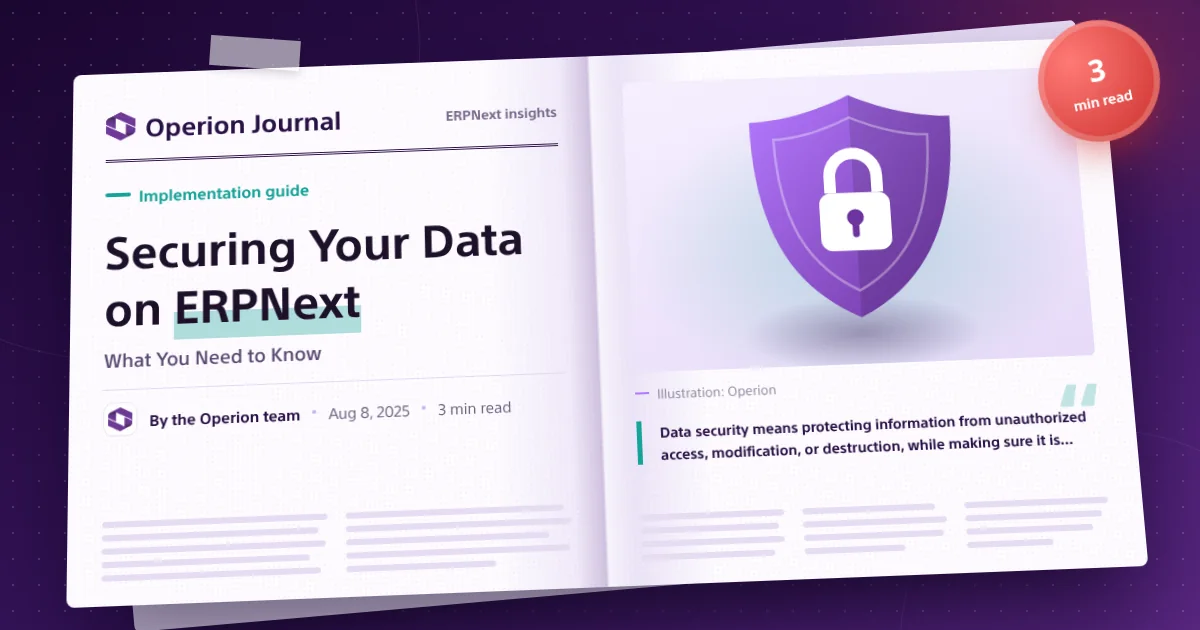
Data security means protecting information from unauthorized access, modification, or destruction, while making sure it is available when needed. In ERP systems it rests on three core elements: 1- Confidentiality: restricting access to sensitive information to authorized users only. 2- Integrity: making sure stored data has not been altered or tampered with. 3- Availability: making sure the system and data remain accessible without interruption. ERPNext is built to apply these three principles according to modern technical standards.
2. User Permission Controls
ERPNext provides granular access control at multiple levels: creating Roles based on job functions; setting read, create, edit, and delete permissions for each document or module; enabling additional restrictions such as permissions by branch or company (User Permissions); and monitoring activity through an Audit Trail that records every change made in the system. These controls protect sensitive data from unauthorized access and human error.
Data security means protecting information from unauthorized access, modification, or destruction, while making sure it is available when needed
3. Encryption and Connection Security
All communication between the ERPNext server and users is secured with HTTPS (SSL/TLS), which prevents eavesdropping and tampering while data travels over the internet. Organizations running the system on-premise are also advised to enable database encryption and file backup encryption, to ensure full protection against unauthorized access even in the case of a physical breach.
4. Backup and Data Recovery
A regular backup system is one of the pillars of security. ERPNext provides automatic mechanisms for backing up databases and files, either daily or weekly depending on company policy, or to remote servers (Remote Backups) for disaster recovery. A data restoration test is an essential step to confirm that backups are ready and effective.
5. Regular Updates and Security Patches
Because ERPNext is an open-source project, it continuously receives security patches that fix vulnerabilities and improve performance. Keeping the system updated regularly is recommended to maintain the best level of security. The Auto Update feature in Frappe Cloud is an example of centralized update management that applies patches quickly without disrupting the system.
6. Cloud Data Protection
For organizations using ERPNext on cloud hosting, approved providers (such as Frappe Cloud) apply multiple layers of protection, including: advanced firewalls; intrusion detection and prevention systems (IDS/IPS); encryption of data in transit and at rest; and continuous infrastructure monitoring. These measures protect data fully while keeping system performance high.
7. Compliance with Standards and Corporate Policies
An important aspect of information security is alignment with international standards such as: ISO 27001 for information security management systems, and GDPR for data privacy protection in the European Union. ERPNext also lets you apply internal compliance policies such as retaining records for set periods, encrypting sensitive data, and documenting access.
Conclusion
Securing data in ERPNext is not just a technical option. It is an organizational commitment that ensures business continuity, customer trust, and protection of the organization's digital assets. By combining access controls, backups, continuous updates, and standards compliance, organizations can achieve a safe and reliable operating environment.