
 Operion Journal
What is an ERP system?
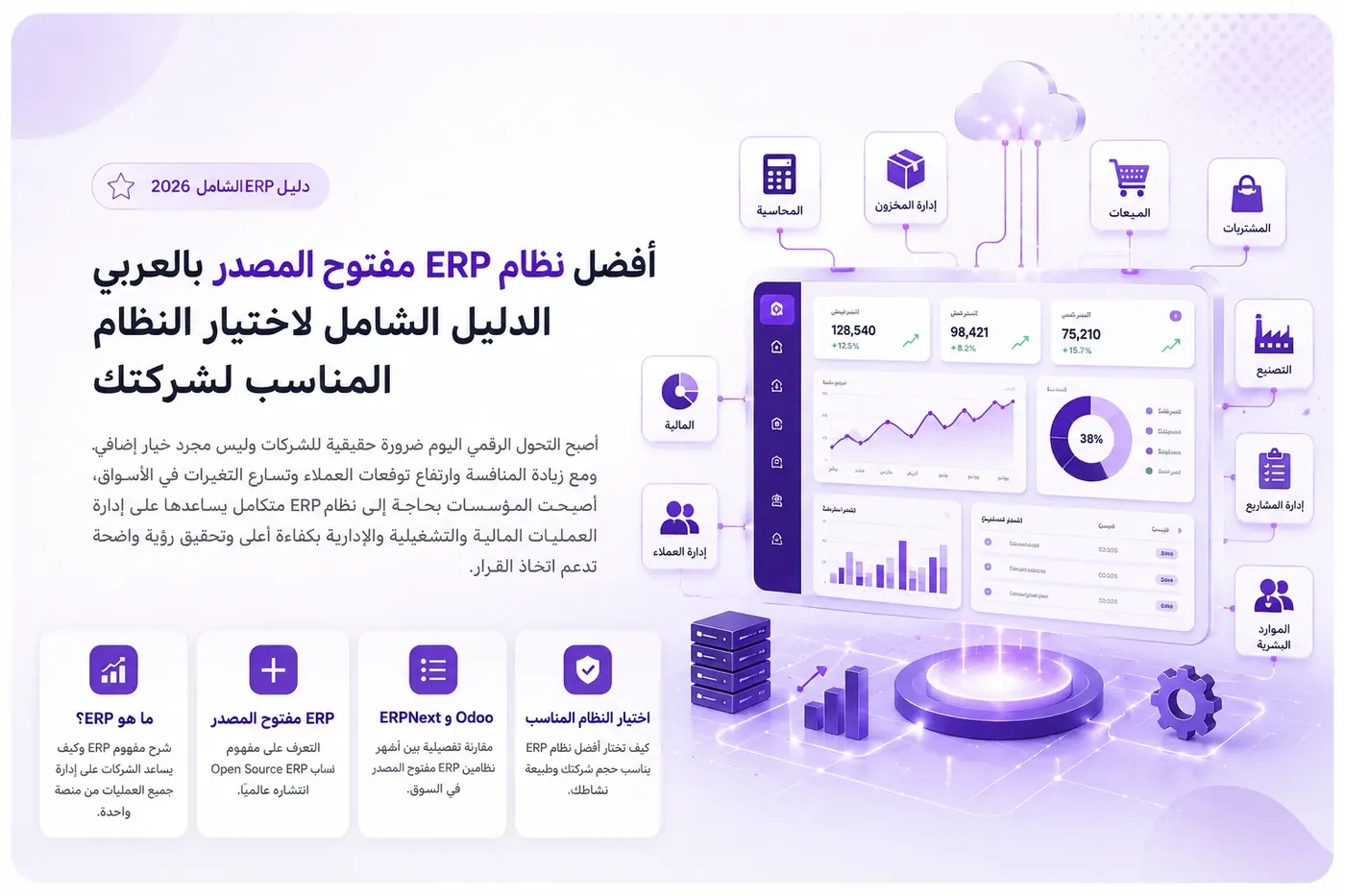
ERP stands for Enterprise Resource Planning. It is a system that helps companies manage all of their operational, financial, and administrative processes from one connected platform, instead of using several separate systems.
One platform for every department
Instead of each department working in isolation, an ERP system connects accounting, sales, purchasing, inventory, HR, and projects in a single database, giving you a complete, accurate view of every operation.
Better decision-making
Accurate, up-to-the-minute reports help management make faster, more precise decisions.
Fewer duplicates and errors
Data is entered once and automatically flows to every connected department.
A practical example inside an ERP system
Why do companies need an ERP system?
In a company's early growth stages, Excel files or separate programs may be enough to run daily operations. As the business grows, operational and management challenges start to appear that hurt efficiency and profitability.
The more customers, employees, orders, and financial transactions you have, the more important a unified platform for data and processes becomes. This is where ERP systems come in, connecting every department in one integrated work environment.
Duplicate data entry
The same data is entered more than once in different systems, wasting time and raising the chance of errors.
Delayed reports
Financial or operational reports can take days to prepare because data is scattered across departments.
Inventory errors
Differences between physical stock and what the system shows cause losses and delays in fulfilling orders.
Hard-to-track performance
Without a unified view of operations, it is hard to follow profits, projects, and productivity and make the right decisions.
How does ERP solve these problems?
An ERP system connects all departments in a single database, so information updates in real time across accounting, sales, purchasing, inventory, HR, and projects. The result is fewer errors, faster processes, better reports, and decisions based on accurate data.
Accurate, up-to-the-minute reports help management make faster, more precise decisions
What is open source ERP?
Open source ERP is an enterprise resource planning system that lets companies access the system's source code and customize and extend it to their needs, instead of depending entirely on a closed-source software vendor that controls every aspect of the system.
Why has open source ERP become more popular?
In recent years, thousands of companies around the world have turned to open source ERP systems for their flexibility, customizability, and lower long-term cost of ownership compared with traditional closed systems.
Traditional ERP
Open source ERP
Key advantages of open source ERP
High flexibility
The system can be modified to fit the way your business works.
Scalability
Supports company growth and lets you add new modules later.
Full control
Greater ownership of your data, processes, and customizations.
A global community
Thousands of developers and partners around the world contribute to development.
Why are companies moving to open source ERP?
Choosing an ERP system is no longer just a technical decision. It is a strategic one that affects operational efficiency, profitability, and the ability to scale. That is why more and more companies worldwide are turning to open source ERP.
The goal is no longer just buying software
Modern companies want a platform that gives them flexibility, control, and scalability without being locked into a single vendor or ever-rising license costs. This is where open source systems shine.
More flexibility
Processes, forms, and reports can be customized to fit your business, instead of changing your procedures to fit the system.
Less vendor dependence
A company can choose the implementation partner or development team that suits it, without being tied to a single company.
Scalability
You can add users and modules and grow the system as the company grows, without replacing the platform.
More control over data
The company has more flexibility in managing data, integrations, backups, and operating strategies.
What do modern companies look for?
Future growth without complexity
Full control over operations and data
Pros and cons of open source ERP
Like any strategic decision, choosing an open source ERP means understanding both the advantages and the challenges. These systems offer great flexibility, but project success also depends on how it is implemented and on choosing the right partner.
Advantages
High flexibility in customizing processes, forms, and reports.
Freedom to choose the right implementation partner or development team.
Room to scale with the company without replacing the system.
Less dependence on a single company that controls all updates and development.
A large global community of developers and partners contributing to continuous development.
More flexibility in managing data, integrations, and hosting.
Challenges and drawbacks
Requires choosing an implementation partner with real experience in the system.
Some projects may need custom development depending on the nature of the business.
Project success depends on training and change management inside the company.
Some customizations may require advanced technical expertise.
Choosing an unsuitable hosting provider can affect performance and stability.
The lack of a clear implementation plan can delay the expected results.
Bottom line: when is open source ERP the right choice?
If your company is looking for flexibility, scalability, and greater control over operations and data, open source ERP is a very strong option. Still, success does not depend on the system alone. It also depends on choosing an implementation partner with the right experience and methodology for implementation, training, and ongoing support.
ERPNext or Odoo?
When companies start searching for the best open source ERP, they often end up with two main options: ERPNext and Odoo. Both have large user bases worldwide, but each has a different philosophy and strengths that may make it the better fit for a certain type of company.
An integrated ERP platform built on Frappe Framework, known for ease of administration, tight integration between modules, and a focus on user experience.
A widely used global business platform built on a multi-app system, offering a huge range of modules and add-ons.
What will we compare?
Accounting
Financial strength, reporting, and journal entries.
Inventory
Managing items, warehouses, and stock movements.
Manufacturing
Managing production, raw materials, and planning.
Ease of use
User experience, customization, and scalability.
ERPNext overview
ERPNext is one of the best-known open source ERP systems in the world. In recent years it has built a large user base of thousands of companies across industries, from small and mid-sized businesses to large organizations.
ERPNext is more than ERP software
ERPNext was developed by Frappe Technologies and is built on Frappe Framework, an integrated development environment that makes it easy to build and customize applications. ERPNext is a unified platform that combines accounting, sales, purchasing, inventory, manufacturing, HR, and project management in one connected system.
An integrated platform
ERPNext provides all the core modules companies need on one platform, without having to buy dozens of separate add-ons.
Fully open source
The system can be customized and extended to the company's needs without traditional licensing restrictions.
Strong in manufacturing and accounting
ERPNext is very strong in manufacturing, inventory, and accounting, which makes it a preferred choice for factories, contracting companies, and distributors.
Ease of use
A modern interface and consistent user experience help employees learn and work faster than with many traditional systems.
ERPNext's key strengths
Strong accounting
Advanced financial reports and comprehensive account management.
Advanced manufacturing
BOM, MRP, Work Orders, and production management.
Integrated inventory
Professional management of items, warehouses, and stock counts.
Easy customization
Modify forms, processes, and reports with ease.
Hosting flexibility
Run it on-premises, in the cloud, or through Frappe Cloud.
Thousands of developers and partners around the world contribute to its development.
Odoo overview
Odoo is one of the most widely used business systems in the world. It stands out for offering a very large number of apps that cover every aspect of running a company, which has made it a popular choice for organizations of all sizes.
An app-based integrated business platform
Odoo is built on the philosophy of separate apps, and companies can pick the ones they need, whether for accounting, sales, CRM, manufacturing, or HR. It also has a huge marketplace of add-ons and apps that extend its capabilities.
A large number of apps
Odoo offers a wide range of apps covering most administrative and operational processes inside companies.
Wide global adoption
A large number of companies and partners around the world use Odoo, creating a broad ecosystem of services and support.
A huge add-on marketplace
A large number of ready-made apps and add-ons help companies add new functionality quickly.
Flexibility in building solutions
A variety of solutions can be built by combining different apps to fit company needs.
Odoo's key strengths
Multiple apps
A large library of specialized apps.
Global reach
A broad base of users and partners around the world.
Multiple ways to scale
New apps and modules can be added easily.
A broad ecosystem
Thousands of add-ons and ready-made solutions.
Configuration flexibility
Different business scenarios can be built.
Multi-industry solutions
Suitable for a wide range of activities and industries.
ERPNext or Odoo for accounting?
Accounting is one of the biggest factors in choosing an ERP system. That is why it is important to understand the differences between ERPNext and Odoo in account management, financial reporting, and day-to-day accounting operations.
A complete, ready-to-use chart of accounts.
Automatic journal entries linked to all operations.
Cost centers, projects, and detailed profitability.
Powerful financial reports built into the system.
Strong links between inventory, accounting, and manufacturing.
A modern, easy-to-use interface.
Supports core and advanced financial operations.
Good integration with other Odoo apps.
Some advanced functions may need additional add-ons, depending on the version.
ERPNext often has the edge in complex accounting environments
If your company relies heavily on financial accounting, cost centers, and linking operations directly to accounts, ERPNext delivers a strong, integrated experience out of the box. Odoo also offers an excellent experience, but in some scenarios it depends on adding apps or extra components to reach the accounting depth some companies need.
ERPNext or Odoo for manufacturing and factory management?
For factories, choosing an ERP system doesn't depend only on accounting or inventory. It depends heavily on how well the system manages production, raw materials, planning, quality, and cost in a connected way.
Manufacturing is ERPNext's biggest strength
Many experts consider ERPNext one of the strongest open source ERP systems for manufacturing, because most core manufacturing functions are built in without needing many external add-ons.
MRP and material requirements planning.
Quality Inspection & Quality Control.
Integrated product costing.
Supports core manufacturing operations.
Provides good tools for managing production.
Good integration with other apps.
Some manufacturing scenarios may require specialized add-ons.
The level of depth depends on the apps used.
The key manufacturing functions factories look for
BOM
Managing the product structure and its components.
MRP
Planning raw material requirements.
Costing
Calculating product cost accurately.
Quality
Inspection and quality control during production.
Who wins in manufacturing?
In most industrial projects and mid-sized to large factories, ERPNext is one of the strongest options among open source ERP systems. This is because the main manufacturing functions are built in and connected with accounting, inventory, and purchasing, making it a preferred choice for many factories in the Middle East.
ERPNext or Odoo for inventory and procurement?
Inventory and supply chain management are among the processes with the biggest impact on profitability. That is why it is important to compare how well each system manages items, warehouses, purchasing, and supply.
Batch and Serial Number management.
Direct integration with sales and manufacturing.
Stock reports and item movement analysis.
Strong warehouse and logistics management.
Supports multi-tier supply chains.
Integration with the sales and purchasing apps.
Advanced options depending on the apps used.
What companies look for in inventory management
Warehouses
Managing multiple warehouses and branches.
Purchasing
Requests, purchase orders, and suppliers.
Tracking
Batch & Serial Tracking.
Reordering
Prevent stockouts and improve supply.
Who wins in inventory management?
Both systems offer strong inventory and supply chain capabilities. Still, many users prefer ERPNext when deep integration between inventory, accounting, and manufacturing on one platform is the priority, while Odoo stands out in environments that rely on many specialized apps within its ecosystem.
ERPNext or Odoo for customization and development?
Customization is one of the most important factors in the success of any ERP project, because every company has procedures, forms, and reports that differ from the next. That makes how easy it is to develop and modify the system a decisive point when choosing.
Easy creation of Custom Fields.
Form customization without coding in many cases.
Built on Frappe Framework.
Easy to build fully custom apps.
A huge marketplace of ready-made add-ons.
Ability to build custom Modules.
Wide options for advanced development.
Relies more on developer expertise.
How are customizations usually done?
Requirements analysis
Understanding the company's current needs.
Process design
Building a workflow that fits the business.
Development
Adding the required forms and reports.
Testing
Making sure all processes work correctly.
Who wins in customization?
Both systems offer high customization flexibility, but ERPNext makes it easy to make many changes directly inside the system using built-in Frappe tools, while Odoo benefits from a very large add-on ecosystem. For many mid-sized companies, ERPNext is a faster, easier choice for day-to-day customization and managing future changes.
ERPNext or Odoo on cost?
When evaluating any ERP system, don't look only at the purchase or subscription price. Look at the total cost of ownership (TCO), which includes implementation, customization, training, support, hosting, and future expansion.
Fully open source.
Lower costs in many mid-sized projects.
Most core modules are built in.
Great flexibility in choosing hosting and implementation partner.
Offers multiple subscription and licensing options.
Cost can vary depending on the apps required.
Some projects need paid add-ons.
Scaling cost depends on the number of users and apps.
What affects the cost of an ERP project?
Implementation
Process analysis and system setup.
Customization
Reports, forms, and custom development.
Hosting
Cloud or on-premises, depending on the company's needs.
Support and training
Building user skills and ensuring project success.
Who wins on cost?
For many small and mid-sized companies, ERPNext tends to offer a lower long-term cost of ownership because most core functions are built into the system. Still, the final cost of any project depends on the scope of work, the number of users, customization requirements, and the implementation partner's experience more than on the name of the system itself.
Final verdict: ERPNext or Odoo?
The truth is that no single system fits every company. The right choice depends on the nature of the business, the company's size and goals, and its future growth plan. Still, the decision can be summed up in the following points.
Choose ERPNext if your company needs:
Strong integration between accounting, inventory, and manufacturing.
To manage factories or contracting projects.
Great flexibility in customization and development.
Lower total cost of ownership over the long term.
An integrated ERP on a single platform.
Choose Odoo if your company needs:
A very large number of apps and add-ons.
To rely on the Odoo App Store ecosystem.
To extend the system with a variety of ready-made apps.
To tap a wide global market of partners.
Ready-made solutions for a large number of scenarios.
Comparison summary
Strong financial and accounting integration.
A clear advantage for factories and production.
Add-ons
A huge app ecosystem.
Lower cost of ownership in many cases.
Need help choosing the right system?
The Operion team helps companies study their needs, analyze their processes, compare systems, and choose the best ERP solution based on actual business requirements, not just marketing or brand recognition.
Choosing the right system for your business
What is the best ERP system for your type of business?
The right ERP system varies from company to company depending on the nature of the business, day-to-day operations, and operational challenges. Below are the main industries that benefit from ERPNext and why it is a strong choice for each.
Factories
If you run a factory, ERPNext provides advanced tools to manage production, costs, quality, and raw materials from one connected platform.
Contracting companies
Manage projects, costs, progress billing, and subcontractors in one system that improves financial and operational control.
Trading and distribution
A good fit for companies that manage large inventories and multiple branches and need accurate visibility into item movement and sales.
Retail
Manage points of sale, branches, inventory, and promotions in a unified environment that improves the customer experience and operating efficiency.
Service companies
Ideal for companies that rely on projects, contracts, HR, time tracking, profitability measurement, and better use of resources.
Education and training
Helps educational institutions and training centers manage administrative and financial operations, students, and training courses from one platform.
No single ERP system fits everyone
The best ERP system is the one that matches the nature of your business, your day-to-day operations, and your future growth goals. A successful selection process starts by understanding the company's needs, then choosing the platform that delivers the highest operational and investment value over the long term.
Why has ERPNext become a preferred choice for Arab companies?
In recent years, adoption of ERPNext among Arab companies has grown noticeably, especially in Egypt, Saudi Arabia, Kuwait, and Qatar. This is because it combines flexibility, a reasonable cost, and support for local business requirements in a modern, integrated ERP platform.
Arabic language support
ERPNext offers excellent Arabic support and a user interface suited to companies that work in Arabic or need a bilingual work environment.
VAT
The system can easily be configured to meet VAT requirements in many Arab countries and to prepare the required tax reports.
E-invoicing
Many companies are looking to connect their systems to e-invoicing requirements, and ERPNext provides the flexibility to build these integrations.
High flexibility in customization
Companies can modify forms, reports, and workflows to fit their operational needs without being bound to rigid templates or fixed processes.
Cloud hosting
ERPNext can run on Frappe Cloud or any other cloud environment, providing easy access, security, and continuous backup.
Affordable cost for growth
The cost of implementing and running ERPNext is affordable for many small and mid-sized companies compared with many other commercial ERP systems.
Egypt
Adoption of ERPNext is growing in the Egyptian market to support accounting, inventory, manufacturing, digital transformation, and e-invoicing requirements.
Saudi Arabia
Saudi companies use ERPNext to manage operations, meet VAT requirements, and improve operational efficiency.
Kuwait
ERPNext gives Kuwaiti companies a flexible, scalable platform that supports growth, expansion, and centralized data management.
Qatar
ERPNext is a good fit for Qatari companies looking for a modern ERP system that supports projects, operations, and financial control.
Why does ERPNext succeed in the Arab region?
ERPNext's success is not only because it is open source ERP. It combines flexibility, easy customization, and a reasonable cost with the ability to support the requirements of different Arab markets. That is why it is increasingly popular among companies that want to build an integrated digital operating environment that can grow with them.
ERP Implementation Journey
A Successful ERP Implementation Journey, Step by Step
The success of an ERP project does not depend on choosing the system alone. It depends mainly on the implementation methodology. Successful companies follow a clear journey that starts with understanding business needs and ends with go-live and continuous improvement.
Requirements analysis
The journey starts with understanding the company's goals, current challenges, and the operational requirements the new system must cover.
Reviewing current processes
The current workflow across departments is analyzed to identify strengths, problems, and opportunities for improvement.
Solution design
Once requirements are understood, the right system structure is designed, with the required modules, workflow, and reports defined.
Setup and customization
The system is set up, and forms, workflows, permissions, and reports are customized to fit the nature of the company's business.
Testing and validation
Before going live, all processes and business scenarios are tested to confirm data accuracy and the soundness of procedures and reports.
Training and knowledge transfer
Users are trained on the new system, with daily procedures, reports, and workflows explained so the team is ready before go-live.
Go-Live
The company moves to the live environment and starts using the system in daily operations, with close follow-up during the first period.
Ongoing support and development
The ERP journey doesn't end at go-live. Continuous improvement begins, with new enhancements and better usage to get the most out of the system.
ERP project success starts with the right methodology
The main reason ERP projects succeed or fail has less to do with the system itself than with the implementation methodology. When needs are analyzed correctly, users are trained, and change is managed professionally, the chances of success rise significantly and the expected operational and financial benefits are achieved.
Is ERPNext the right choice for your company?
After reviewing ERPNext's strengths and its use across different industries, it is clear that the system is a strong choice for companies that want an integrated platform combining flexibility, scalability, and a reasonable cost in a single operating environment.
ERPNext is right for you if you:
Run a factory that needs to manage production, quality, and costs.
Own a contracting company that relies on projects and progress billing.
Work in trading and distribution and inventory management.
Need an ERP system that can be customized and extended.
Key benefits you get
One platform for all operations.
Arabic language and tax support.
High capacity for growth and expansion.
Start your digital transformation journey with Operion
Whether you are evaluating an ERP system or looking for an implementation partner with hands-on experience in ERPNext and Frappe Framework, the Operion team is ready to help you analyze your company's needs, choose the right solution, and deliver the project following best practices.
ERPNext FAQs
Here are the questions business owners and managers ask most often when researching ERPNext and choosing the right ERP system for their business.
ERPNext is an open source ERP system that helps companies manage accounting, sales, purchasing, inventory, HR, manufacturing, and projects from one integrated platform.
ERPNext is open source, but there may be costs for hosting, customization, training, and technical support depending on the company's needs.
Is ERPNext suitable for small and mid-sized businesses?
Yes. ERPNext is one of the best options for small and mid-sized businesses thanks to its flexibility, easy scalability, and reasonable cost of ownership compared with many other systems.
Yes. ERPNext includes powerful manufacturing modules, including BOM, MRP, Work Orders, quality management, and production planning.
Does ERPNext support Arabic?
Yes. ERPNext supports Arabic well, and the system can run in multiple languages within the same environment.
Does ERPNext support VAT?
Yes. ERPNext can be configured to meet VAT requirements and tax regulations in many Arab countries.
What is the difference between ERPNext and Odoo?
Both systems are strong, but ERPNext stands out for tight integration between modules, easy customization, and a cost of ownership that suits many companies.
Can ERPNext be hosted in the cloud?
Yes. ERPNext can run on Frappe Cloud or any suitable cloud hosting provider, according to the company's requirements.
Yes. ERPNext is one of the most customizable ERP systems, letting you modify forms, workflows, reports, and integrations to fit business needs.