
 Operion Journal
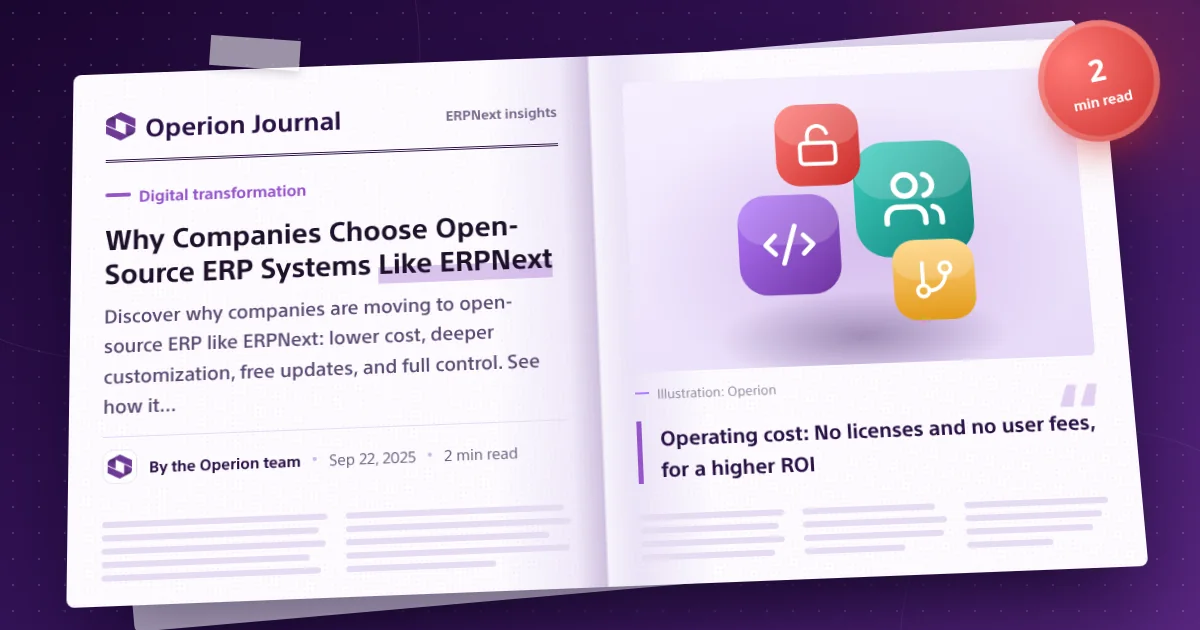
In recent years, thousands of companies worldwide have moved to open-source systems instead of traditional closed software, and the reason is simple: more freedom, lower cost, and faster evolution. Among these systems, ERPNext stands out as one of the strongest open-source ERP solutions, built to support company growth across industries.
What does "open source" mean for an ERP system?
It is a system where you can: view its source code; modify it to fit your company; extend it and connect new functions to it; all without restrictions from the owning vendor. In short, the system becomes entirely yours.
Why are companies moving to open-source ERPNext?
Feature / ERPNext. Operating cost: No licenses and no user fees, for a higher ROI. Flexibility and customization: Adapts to the nature of your business, with easy, unlimited customization. Developer community: Thousands of developers and companies continuously support the system. Integration with other systems: An open API ready to connect with POS, eCommerce, and Payment systems. Annual updates: Completely free, with features and improvements at no extra cost.
Operating cost: No licenses and no user fees, for a higher ROI
ERPNext vs closed-source systems:
Item / Closed systems / Open-source ERPNext. Cost: Very high / Economical and flexible. Customization: Limited and weak / Open and complete. Updates: Paid and slow to arrive / Free and continuous. Future development: Stops without extra payment / Constantly renewed and open to everyone. Ownership and control: Limited permissions / Full control over data and operations.
The bottom line:
Choosing an open-source system like ERPNext means: technical freedom, full control, lower cost, continuous development, and a secure future. Simply put, it is a smart strategic decision for any company that wants to grow with confidence.