
 Operion Journal
Your ERPNext Learning Roadmap: From Zero to Pro
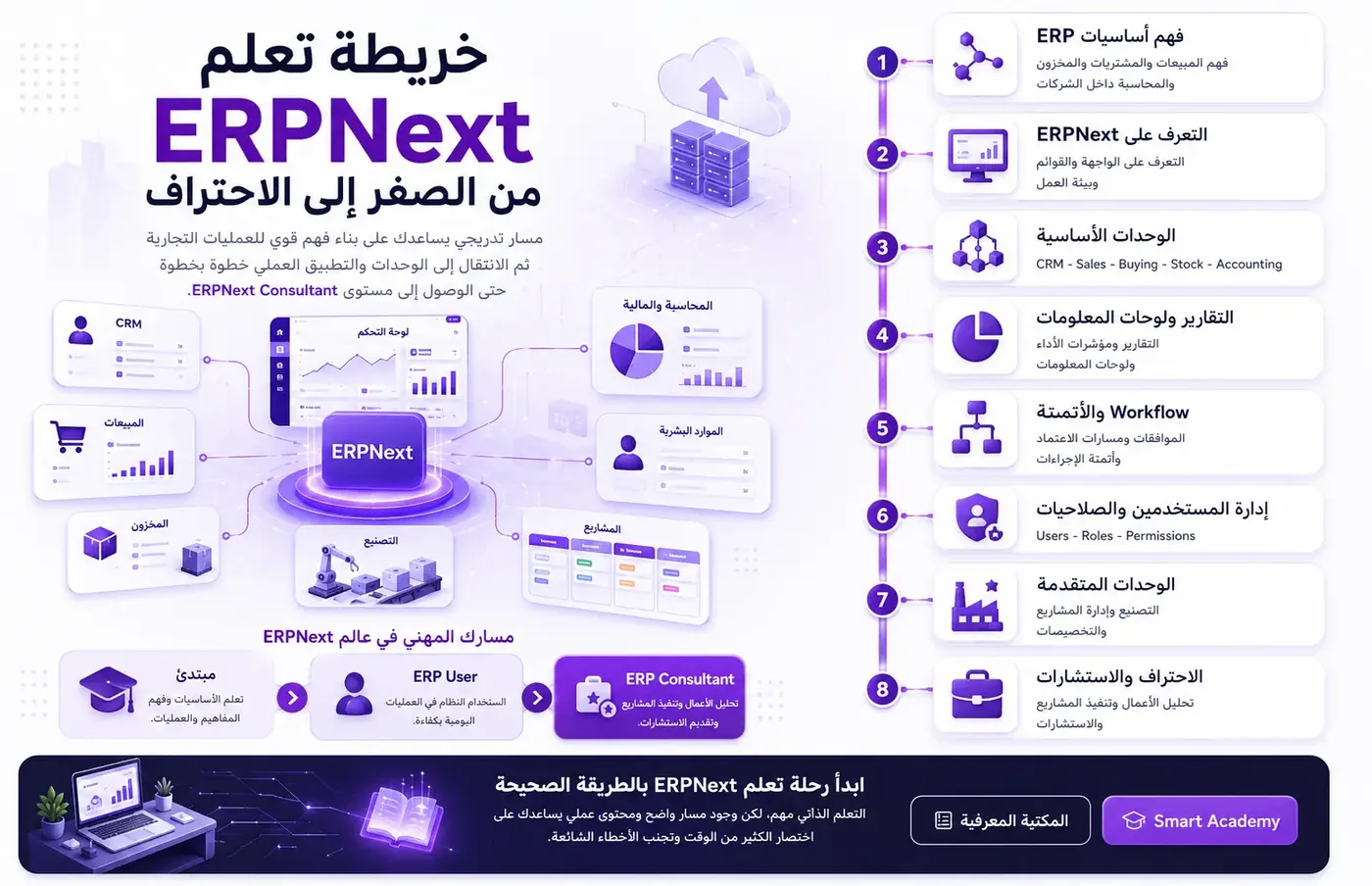
One of the biggest mistakes beginners make is trying to learn all of ERPNext at once. The right way is a gradual path that builds a strong understanding of business processes first, then moves on to modules and hands-on practice, step by step.
Understand ERP Basics
Start by learning what ERP is and how sales, purchasing, inventory, and accounting work inside companies, before you begin using the system.
Get to Know ERPNext
Learn the interface, Workspaces, lists, search, forms, and how to navigate the ERPNext environment.
Core Modules
Start with CRM, Selling, Buying, Stock, and Accounting, because they cover the daily operations of most companies.
Reports and Dashboards
Learn to read data, analyze reports, and build dashboards and KPIs.
Workflow and Automation
Learn to build approval workflows inside companies and tie them to permissions and operating procedures, improving governance and reducing errors.
User and Permission Management
Get to know Users, Roles, and Permissions, and how to protect data and separate duties professionally inside ERPNext.
Advanced Modules
Once you have mastered the basics, move on to Manufacturing, Projects, HR, integrations, and advanced customization based on your professional focus.
Mastery and Consulting
Start taking part in real projects and learn business analysis, change management, and consulting until you reach the level of ERPNext Consultant.
Start Your ERPNext Learning Journey the Right Way
Self-study matters, but a clear path and practical content save you a lot of time and help you avoid common mistakes. You can use the free knowledge library or join specialized training programs to speed up your learning and reach professional level.
Who Can Learn ERPNext?
One of ERPNext's best qualities is that it is not limited to one type of user. Whether you are an accountant, a stock keeper, a project manager, or a software developer, you can use ERPNext to build a strong career in digital transformation and ERP systems.
Accountant
Learn daily journal entries, financial reports, customer and supplier accounts, and tax management with ERPNext.
Stock Keeper
Manage warehouses, balances, stock counts, item movements, batches, and serial numbers with high efficiency.
HR Manager
Manage employees, leave, attendance, and performance reviews on one integrated platform.
Project Manager
Track tasks, resources, costs, and work hours, and analyze project profitability with ERPNext's advanced tools.
Factory Manager
Manage production, raw materials, quality, work orders, production requirements planning, and product cost control.
Software Developer
Learn Frappe Framework, custom app development, integrations, and APIs, and build advanced ERP solutions.
⭐ ERP Consultant: The Most In-Demand Career Path
ERP consulting is one of the fastest-growing career paths in the job market today, because it combines an understanding of business processes with the ability to analyze company needs, implement systems, and improve operational performance.
Managing Digital Transformation Projects
Start Building Your ERPNext Career
Whether you are a beginner user or aiming for the ERP Consultant level, you can use specialized learning content and practical training paths to build your skills faster.
Start by learning what ERP is and how sales, purchasing, inventory, and accounting work inside companies, before you begin using the system
ERP User or ERP Consultant?
As you learn ERPNext, you will find two very different paths. The first is using the system in daily work inside a company. The second is mastering the system and working as an ERP consultant who helps companies with digital transformation and system implementation.
ERP User
Carries out daily operations in the system.
Enters data and creates documents.
Uses reports and tracking dashboards.
Focuses on one department, such as accounting or stock.
Needs to understand the processes of their own role.
ERP Consultant
Analyzes companies' business processes.
Trains users and manages change.
Understands all system modules end to end.
When Should You Choose the ERP User Path?
If you work inside a company and need to use ERPNext for daily tasks such as accounting, sales, stock, or HR, focusing on the ERP User path is enough to get excellent results in your job.
When Should You Choose the ERP Consultant Path?
If you want to work in system implementation, consulting, digital transformation, or ERP project management, you will need to learn ERPNext in more depth and understand business processes across departments.
Which Path Is Right for You?
Neither path is better than the other. It depends on your career goals. Many successful ERP consultants started as users of the system inside their companies and gradually moved into business analysis, project management, and consulting. What matters is to start learning by doing and build your experience step by step.
The Key ERPNext Modules to Learn First
You don't need to learn every ERPNext module at once. Start with the core modules most companies use, then expand gradually into advanced modules based on your specialty and career path.
CRM
Learn to manage leads, sales opportunities, the sales pipeline, and customer relationships from first contact to closing the deal.
Leads • Opportunities • Pipeline
Sales
Understand the full sales cycle, from quotations to sales orders, invoices, and collections.
Quotation • Sales Order • Invoice
Purchasing
Learn to manage suppliers, purchase requests, purchase orders, goods receipt, and purchasing costs.
Suppliers • RFQ • Purchase Order
Inventory
Manage stock, warehouses, item movements, counts, tracking, serial numbers, and batches.
Warehouses • Stock Entries • Serial No
Accounting
Understand the chart of accounts, daily journal entries, bank reconciliation, financial reports, and analysis of the company's financial performance.
GL • Journal Entry • Financial Reports
HR & Payroll
Manage employees, leave, attendance, the org structure, and payroll in one integrated system.
Employees • Attendance • Payroll
Projects
Track tasks, work hours, budgets, resources, project profitability, and execution.
Tasks • Timesheets • Project Costing
Manufacturing
Learn production management, work orders, raw materials, quality, and manufacturing requirements planning (MRP).
What Is the Best Order for Learning the Modules?
If you are a beginner, start with CRM, then Selling, Buying, and Stock, and then move on to Accounting. Advanced modules such as Projects, Manufacturing, and HR are best learned after you have mastered the basics and understand the full business cycle inside companies.
Keep Building Your ERPNext Skills
Each ERPNext module is an entire field of knowledge. You can go deeper through tutorials and specialized articles, or join hands-on training programs to speed up your learning.
The Final Plan to Become an ERPNext Consultant
Reaching the level of ERPNext consultant is not about memorizing menus or knowing screens. It takes a real understanding of business processes, project management, and hands-on practice. Here is the path most successful consultants follow.
Start by understanding what ERP is, how the work cycle runs inside companies, and how the different departments integrate with each other.
Master the Core Modules
Focus on CRM, Selling, Buying, Stock, and Accounting, because they are the foundation of most ERPNext projects.
Hands-On Practice
Build a test environment and run real scenarios yourself instead of only watching or reading.
Understand Business Processes
Learn how sales, purchasing, inventory, and accounting actually work inside companies, not just inside the system.
Join Real Projects
Start taking part in real ERPNext implementation projects, even in a limited scope. Hands-on experience is the single biggest factor in building a successful ERP consultant.
Earn Certifications and Specialized Training
Professional certificates and specialized courses help you organize your knowledge and prove your level of expertise to companies and prospective clients.
Client Management and Workshops
Learn how to gather requirements, analyze processes, run meetings and workshops, and deliver the right solutions to clients.
Reach the ERPNext Consultant Level
By combining theoretical knowledge, hands-on experience, and business analysis skills, you will be able to lead ERPNext projects and provide professional consulting to companies.
Mastery Doesn't Come from Watching Lessons Alone
The real difference between an ordinary user and a professional ERPNext consultant is the ability to understand companies' needs and turn them into practical, workable solutions. So always focus on hands-on practice and real projects alongside theory.
Start Your Journey to ERPNext Mastery
If you are serious about building a career in ERP and digital transformation, start today with a structured learning plan that combines theory and hands-on practice. You'll find specialized training programs at Smart Academy, and dozens of free articles and guides in the Knowledge Library to support your journey.
Smart Academy and Its Role in Developing Talent
One of the biggest challenges companies face when implementing ERP systems is a shortage of qualified people to manage, run, and develop them. That is why Smart Academy was created: a specialized platform for building and qualifying professionals.
Building a New Generation of ERPNext Experts
Smart Academy offers hands-on training programs that help users, consultants, and developers gain the skills they need to work effectively with ERPNext, Frappe Framework, and digital transformation projects.
The First Arabic Academy Certified by Frappe School
Smart Academy is an important step in spreading ERPNext technical and management knowledge across the Arab region, through professional training content that combines theory with realistic hands-on practice.
Frappe School
An official accreditation that backs the quality of the content and the training path.
Programs focused on real-world application and realistic scenarios, not just theory.
Preparing Consultants
Qualifying ERPNext consultants who can analyze businesses and manage implementation projects effectively.
Professional Certificates
Certificates that help advance your career, improve job prospects, and prove professional competence.
Start Your Learning Journey with Smart Academy
Whether you are a user, consultant, or developer, Smart Academy offers the right training paths to build your professional skills in ERPNext and digital transformation.
ERPNext Learning FAQ
If you are starting your ERPNext learning journey, here are the questions most often asked by trainees and people interested in working with ERP systems and digital transformation.
Do I need a technical background to learn ERPNext?
No. Accountants, project managers, HR managers, and stock keepers can learn ERPNext without any prior programming experience.
How long does it take to learn ERPNext?
It depends on your goal. You can learn the basics of the system in a few weeks, while reaching ERP Consultant level takes months of study and hands-on practice.
Which module should I start with?
We recommend starting with CRM, Selling, Buying, and Stock, because they are the foundation most companies rely on for their daily operations.
Is ERPNext in demand in the job market?
Yes. Demand for ERPNext professionals keeps growing as companies in the Arab region expand their adoption of ERP systems and digital transformation.
Can I learn ERPNext for free?
Yes. You can start with the articles, tutorials, and free content in the Knowledge Library, then move on to specialized hands-on training.
What is the difference between an ERP User and an ERP Consultant?
An ERP User uses the system inside a company to get daily tasks done, while an ERP Consultant analyzes the business, designs solutions, implements the system, and manages ERP projects.
Do I need to learn programming?
If your goal is to become an ERP Consultant, you don't need to learn programming. If you want to build apps and advanced customizations, you will need to learn Frappe Framework.
Start by understanding ERP basics, then move on to the core ERPNext modules, and then practice hands-on in a test environment and on real projects.
Ready to Start Learning ERPNext?
Use the free content in the Knowledge Library or join the specialized training programs at Smart Academy to speed up your learning and reach professional level.