
 Operion Journal
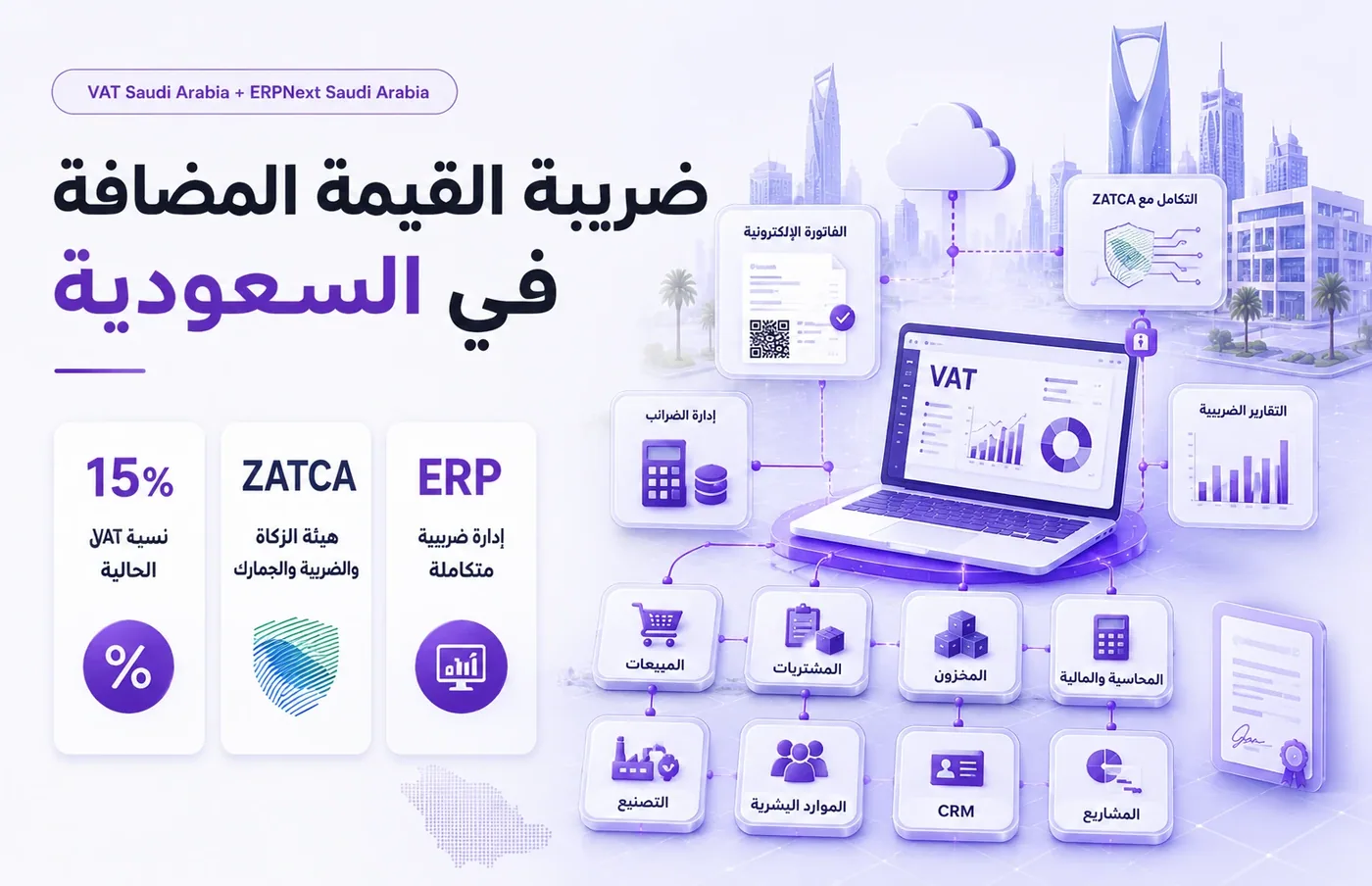
VAT Saudi Arabia + ERPNext Saudi Arabia
If you want a full understanding of value added tax (VAT) in Saudi Arabia, need to know how to manage it inside your company, or are looking for the best ERP to help you comply with the Zakat, Tax and Customs Authority (ZATCA), this complete guide was written for you.
Over the past few years, Saudi Arabia has undergone a broad economic transformation under Saudi Vision 2030, which aims to diversify the economy, strengthen financial sustainability, and raise non-oil revenue. One of the key initiatives in this effort was the introduction of value added tax (VAT) as a core part of the fiscal and regulatory reforms that touched every sector of the economy.
VAT is now a core part of daily operations for Saudi companies, whether they are trading, manufacturing, or service businesses, or online stores. It is no longer just a matter of adding a percentage to an invoice. It requires careful management of taxes, invoices, returns, and statutory obligations, along with integration with accounting and financial systems.
That is why understanding Saudi VAT has become essential for business owners, finance managers, accountants, and operations managers, and even for entrepreneurs planning to launch new ventures in the Kingdom. Modern ERP systems like ERPNext have also become some of the most important tools for managing VAT more accurately and efficiently.
The current rate applied to most goods and services in Saudi Arabia.
Zakat, Tax and Customs Authority
The authority responsible for regulating taxes, e-invoicing, and tax obligations in the Kingdom.
Connect sales, purchasing, accounting, and tax in one platform that supports compliance and reduces errors.
Why Has Understanding VAT Become a Priority for Saudi Companies?
As tax systems evolve and e-invoicing expands under ZATCA requirements, companies are expected to manage their financial and tax data more precisely than ever. Any mistake in calculating tax, issuing invoices, or filing returns can lead to fines or regulatory problems that disrupt the business.
What Do ERP Systems Have to Do With VAT?
As a company grows and its operations become more complex, managing tax by hand gets harder. That is why modern organizations rely on ERP systems like ERPNext to connect sales, purchasing, inventory, accounting, and tax invoices on one platform, which reduces errors and improves tax compliance.
What Will You Learn in This Guide?
In this guide, we explain what VAT is in Saudi Arabia, how it is calculated, who must register, and how to manage tax invoices and returns. We also cover the role of modern ERP systems and ERPNext in simplifying tax compliance and integrating with e-invoicing requirements and the Zakat, Tax and Customs Authority.
Saudi VAT, VAT Saudi Arabia, ERP Saudi Arabia, ERPNext Saudi Arabia, ZATCA, e-invoicing
VAT KSA • Saudi Value Added Tax
What Is Value Added Tax (VAT) in Saudi Arabia?
Value added tax (VAT) is one of the most important indirect taxes in Saudi Arabia, and it directly affects most commercial, service, and industrial activity in the Saudi economy.
VAT is an indirect tax levied on goods and services at each stage of the supply chain, from the purchase of raw materials through manufacturing and distribution until the product or service reaches the final consumer. The tax is calculated as a percentage of the value of the goods or services sold.
Although the tax is collected through tax-registered companies and businesses, the final consumer ultimately bears its real cost. Businesses act as intermediaries who collect the tax and remit it to the Zakat, Tax and Customs Authority (ZATCA) under the applicable regulations and instructions in the Kingdom.
VAT is one of the most widely adopted tax systems in the world and is applied in dozens of countries because it boosts government revenue, supports tax fairness, and reduces reliance on traditional sources of income.
In Saudi Arabia, VAT has become a core part of the daily business cycle. Companies therefore need capable financial and accounting systems to calculate tax, manage tax invoices, and prepare returns accurately and in line with ZATCA requirements.
It is collected through businesses but borne by the final consumer when buying goods or services.
The Zakat, Tax and Customs Authority is responsible for regulating and enforcing the VAT system in the Kingdom.
Modern ERP systems help companies manage VAT, invoices, and tax returns more efficiently.
How Does VAT Work in Practice?
VAT works on a simple but highly effective principle. At every stage of the supply chain, new value is added to the product or service, and tax is calculated on that added value. When a company buys products or services from a supplier, it pays tax on those purchases. When it sells its own products or services to customers, it collects new tax from them.
At the end of the tax period, the company calculates the difference between the tax it collected from customers and the tax it paid to suppliers, and then pays that difference to the Zakat, Tax and Customs Authority. That is why companies need accurate financial records and capable ERP systems to track every tax transaction correctly.
Why Is VAT Important to the Saudi Economy?
VAT plays an important role in increasing government revenue and supporting economic development, infrastructure, and public services. It also helps diversify sources of income and reduce reliance on traditional revenue, in line with the goals of Saudi Vision 2030.
From a business perspective, correct compliance with VAT requirements builds credibility and transparency and reduces regulatory risk and potential fines. It also contributes to better cash flow management and long-term financial planning.
Key Things to Know About VAT
VAT is not just a percentage added to an invoice. It is an integrated financial and operational system that affects sales, purchasing, inventory, accounting, and tax returns. As a company grows, a complete ERP system becomes more important for ensuring compliance and operational accuracy.
VAT Saudi Arabia, VAT KSA, ZATCA, ERP Saudi Arabia, ERPNext Saudi Arabia, e-invoicing
VAT History • Saudi Arabia
The Journey of VAT Implementation in Saudi Arabia
VAT did not appear in Saudi Arabia suddenly. It came as part of a series of economic and regulatory reforms aimed at strengthening financial sustainability and diversifying income sources. Saudi VAT has gone through several important stages to reach its current form.
Before 2018, VAT was not applied in the Kingdom in the form we know today. Most companies operated without needing to manage VAT or file periodic tax returns tied to sales and purchases.
With the launch of the economic transformation programs and Saudi Vision 2030, however, the Kingdom began adopting a set of fiscal initiatives to boost non-oil revenue and improve the efficiency of managing the national economy. The introduction of VAT was one of the most prominent of these initiatives.
The Start of VAT
On January 1, 2018, Saudi Arabia began applying VAT for the first time, at a rate of 5% on most goods and services. This shift was a turning point in the business environment: companies were now required to register for tax, issue tax invoices, and keep financial records in line with ZATCA requirements.
VAT Raised to 15%
In July 2020, the VAT rate was raised from 5% to 15% as part of a set of economic measures aimed at strengthening financial stability. As a result, companies had to update their financial and accounting systems and reconfigure invoices, contracts, and reports to match the new rate.
Maturity and Digital Transformation
After the 15% rate settled in, Saudi companies began focusing on improving their financial and tax systems and strengthening digital compliance. Modern ERP systems became more important than ever, especially as tax reporting requirements, e-invoicing, and integration with various government systems expanded.
E-Invoicing and Digital Compliance
With the launch of e-invoicing requirements by the Zakat, Tax and Customs Authority, companies entered a new phase of digital transformation. Issuing traditional invoices or relying on manual processes was no longer enough. Companies now need systems that can create, manage, and store e-invoices according to the standards approved in the Kingdom.
How Has This Journey Affected Saudi Companies?
The evolution of the VAT system in Saudi Arabia has raised the level of governance and financial transparency inside companies, but it has also created new operational challenges around managing taxes, invoices, reporting, and compliance. That is why thousands of companies have started relying on modern ERP systems like ERPNext to reduce errors, simplify tax processes, and achieve full compliance with ZATCA requirements.
VAT launched at 5%
Rate raised to 15%
Expansion of digital transformation
E-invoicing and compliance
VAT Rate • VAT Categories • ZATCA
It is no longer just a matter of adding a percentage to an invoice
What Is the Current VAT Rate in Saudi Arabia, and What Are the Tax Categories?
Many business owners assume that all goods and services receive the same tax treatment. In reality, the VAT system in Saudi Arabia includes several tax categories that differ by type of activity, service, or product.
The standard VAT rate in Saudi Arabia is currently 15%, which applies to the majority of goods and services traded in the Saudi market. It is the rate most commonly used on tax invoices and in day-to-day transactions between companies and customers.
However, other types of transactions are not subject to the same rate. Some transactions are classified as zero-rated supplies, while others are considered exempt supplies.
Understanding these categories is critically important for companies, accountants, and finance managers, because any mistake in choosing the correct tax treatment can lead to errors in invoices, tax returns, or the calculation of tax owed.
Standard-Rated Supplies
This is the most common category in the Kingdom. It covers most of the commercial, industrial, and service goods and services sold in the Saudi market. In this case, VAT is calculated at 15% and shown clearly on the tax invoice.
Zero-Rated Supplies
For this type of transaction, the tax rate applied is zero percent, but the transaction remains within the scope of the VAT system. This means the company can recover the input tax related to these transactions under the applicable regulations and instructions.
Exempt Supplies
Some activities and transactions are classified as exempt from VAT. In this case, no tax is charged to the customer, and the treatment of related input tax differs from that of standard-rated supplies.
Why Does Choosing the Right Tax Category Matter?
Choosing the right tax category for each transaction is one of the most important responsibilities of a company's finance and accounting teams. Classifying a taxable transaction as exempt, or the reverse, can lead to errors in tax invoices and periodic returns, and may result in tax differences or regulatory fines.
That is why modern companies rely on capable ERP systems like ERPNext to apply tax rules automatically and reduce dependence on manual processing, which is prone to error.
How Do ERP Systems Help Manage VAT?
Modern ERP systems let you create tax rules tied to customers, items, services, and transaction types, so the correct rate is applied automatically when you issue invoices or process purchases and sales.
These systems also help you prepare tax reports, compile the data needed for returns, and monitor tax obligations more accurately and efficiently, which reduces the time and effort needed to manage VAT inside the company.
Quick Summary
Not every transaction in Saudi Arabia is subject to the 15% VAT rate. Some are subject to the standard rate, others are zero-rated, and others are fully exempt. Understanding the correct tax category for each transaction is therefore a key step toward complying with Zakat, Tax and Customs Authority requirements and avoiding financial and tax errors.
15% VAT, Zero-Rated, Exempt Supplies, ZATCA, ERPNext VAT, VAT KSA
VAT Registration • ZATCA • Saudi Arabia
Who Must Register for VAT in Saudi Arabia?
VAT registration is one of the most important statutory obligations that companies and business owners need to understand correctly. Not every business must register in the same way. Requirements depend on revenue, the nature of the activity, and the thresholds set by the Zakat, Tax and Customs Authority.
One of the most common questions among entrepreneurs and business owners in the Kingdom is: do we need to register for VAT? The answer depends mainly on the annual taxable supplies the business makes.
The Zakat, Tax and Customs Authority has set clear rules for when registration is mandatory and when it is voluntary, to ensure tax compliance while taking into account the different sizes of businesses in the Saudi economy.
That is why companies need to monitor their sales and revenue continuously, because exceeding the statutory thresholds without registering can expose a business to violations and fines.
Mandatory Registration
VAT registration becomes mandatory when annual taxable supplies exceed the threshold set by the Zakat, Tax and Customs Authority. In that case, the business must register, issue tax invoices, file periodic returns, and meet all related tax requirements.
Voluntary Registration
In some cases, businesses that have not reached the mandatory threshold may register voluntarily if they meet the approved conditions. This option gives some companies advantages such as recovering input tax and being better prepared for growth and expansion.
What Happens After You Register for VAT?
Once registered for VAT, a business becomes responsible for a set of statutory obligations. These include issuing tax invoices that meet the approved requirements, calculating tax on taxable transactions, keeping financial and tax records, filing periodic tax returns, and paying amounts due on time.
That is why companies need organized financial processes and accurate accounting systems that protect data integrity and make ongoing tax compliance easier.
What Are the Risks of Registering Late?
Late registration or failure to meet tax requirements can result in fines and regulatory penalties under the applicable regulations. Companies may also struggle to manage invoices, recover tax, or deal with some entities and customers that require full tax compliance.
It is therefore important to monitor supplies and revenue regularly and make sure you meet all the requirements set by the Zakat, Tax and Customs Authority.
How Do ERP Systems Help Manage Registration and Tax Compliance?
As a business grows, tracking revenue and taxable transactions gets more complex, and that is where ERP systems like ERPNext prove their value. They help you monitor sales, purchasing, and taxes in real time, prepare tax reports, and manage invoices and statutory obligations in a way that reduces errors and supports full compliance with ZATCA requirements.
Mandatory VAT, Voluntary VAT, ZATCA, ERPNext VAT Saudi Arabia
VAT Process • VAT Workflow • Saudi Arabia
How Does VAT Work in Practice Inside Companies?
Many people assume VAT simply means adding 15% to an invoice, but the reality is more complex. VAT runs through a whole chain of transactions that starts with the supplier and ends with the final consumer, while companies collect the tax, manage it, and settle it with the Zakat, Tax and Customs Authority.
To understand how VAT works, you need to look at the full business cycle. At every stage of supply, new value is added to the product or service, and the tax is charged on that added value, not only on the final product.
This is why VAT is one of the most widely used tax systems in the world: it collects tax gradually across every stage of economic activity instead of placing it on a single stage.
Let's follow a product from supplier to final customer to see how VAT is calculated in practice inside Saudi companies.
Supplier
The supplier sells raw materials or primary products and adds VAT to the invoice issued to the customer or manufacturer.
The Company or Factory
The company buys materials and pays tax on its purchases, then adds new value to the product or service before reselling it.
The Final Customer
The final consumer bears the cost of VAT as part of the final price of the goods or services they receive.
Where Does the VAT That Companies Collect Go?
It is important to understand that companies do not keep VAT as their own revenue. When a company issues an invoice to a customer and adds VAT to it, it is effectively collecting that tax on behalf of the Zakat, Tax and Customs Authority. After the tax differences are calculated, the amount due is paid according to the periodic tax returns.
That is why sales, purchasing, and invoice records must be extremely accurate, because any mistake in calculating tax can affect the final amount owed.
Why Do Companies Need a System to Manage VAT?
As sales, purchases, and invoice volumes grow, managing VAT by hand gets harder. That is why modern companies rely on ERP systems like ERPNext to calculate taxes automatically and link them to sales, purchasing, inventory, and financial accounts.
This helps reduce errors, improve tax compliance, and speed up the preparation of the reports and returns required by the Zakat, Tax and Customs Authority.
A Simple Example of the VAT Journey
To make the idea easier to follow, consider this scenario:
Buying materials
The company bought materials worth SAR 10,000, with 15% VAT added.
Manufacturing or service delivery
The company added new value to the product or service before selling it.
Issuing the invoice
The product was sold to the customer, with VAT calculated on the selling price.
Tax settlement
The difference between output tax and input tax is calculated and paid to the authority.
Input VAT vs Output VAT • VAT Saudi Arabia
Input VAT vs Output VAT: What Is the Difference?
Understanding the difference between input VAT and output VAT is one of the most important concepts for business owners, finance managers, and accountants in Saudi Arabia, because this difference is the basis for calculating the tax owed to the authority.
When a company buys products or services from a supplier, it pays VAT on those purchases. When the company sells its own products or services to customers, it collects new VAT on its sales.
At the end of the tax period, the company does not pay all the tax it collected from customers. Instead, it calculates the difference between the tax collected on sales and the tax paid on purchases, and then settles that difference with the Zakat, Tax and Customs Authority.
Input VAT
This is the VAT a company pays when buying goods, services, raw materials, or operating expenses from suppliers.
This tax is part of the costs a business bears while carrying out its activity, and in many cases it can be recovered or deducted under the applicable tax regulations.
Example: buying raw materials worth SAR 100,000 + 15% VAT. Total input VAT = SAR 15,000.
Output VAT
This is the VAT a company collects from customers when it sells goods or services or carries out contracts and projects.
The company collects this tax on behalf of the Zakat, Tax and Customs Authority, and it is recorded as a tax liability until the tax return is filed.
Example: selling a product to a customer for SAR 200,000 + 15% VAT. Total output VAT = SAR 30,000.
How Is the Tax Actually Owed Calculated?
At the end of each tax period, the company compares the output VAT collected from customers with the input VAT paid to suppliers, and then calculates the difference between them.
Output VAT
Input VAT
Why Does This Formula Matter for Companies?
The difference between input VAT and output VAT is one of the most important financial and tax indicators in any company. Every mistake in recording purchases or sales, or in calculating VAT, can create tax differences that affect the tax return and the company's financial obligations.
That is why modern companies rely on ERP systems like ERPNext to manage tax automatically and link invoices, sales, and purchases to the financial accounts, which helps calculate the tax owed accurately and reduce human error.
Input VAT, Output VAT, VAT Return, ZATCA, ERPNext VAT, Saudi VAT
VAT Return • ZATCA • Tax Compliance
What Is a VAT Return, and How Do Companies File One?
Once a business is registered for VAT, issues tax invoices, and records its sales and purchases, an important stage follows: preparing and filing the VAT return. The VAT return is one of the key periodic obligations companies must meet to stay fully compliant with the requirements of the Zakat, Tax and Customs Authority.
A VAT return is a periodic report that a business submits to the Zakat, Tax and Customs Authority, summarizing its taxable transactions over a set period. It includes total sales and purchases, output VAT, input VAT, and the tax due or refundable.
The purpose of the VAT return is to let the authority verify businesses' tax obligations and monitor their compliance with the applicable regulations and instructions in the Kingdom.
Because preparing the return depends directly on sales, purchasing, and invoice data, the accuracy of the data recorded in the financial or ERP system is a key factor in successful tax compliance.
Collect the Data
The process starts with collecting sales, purchasing, and tax invoice data for the period the return covers.
Calculate the Tax
Total output VAT and input VAT are calculated, and the net tax due or refundable is determined.
Review the Return
The data is reviewed and the invoices and tax treatments are verified before the return is submitted to the authority.
Submit and Pay
Once the return is approved, it is submitted to the Zakat, Tax and Customs Authority and the tax due is paid within the statutory deadline.
What Are the Most Common Mistakes When Preparing a VAT Return?
Some companies make recurring mistakes when preparing returns, such as recording incomplete invoices, applying incorrect tax rates, missing taxable transactions, or relying on inaccurate manual data. These mistakes can lead to tax differences, fines, and regulatory problems that are easily avoided with an integrated financial system.
The more accurate and well organized the data in the system, the faster, more reliable, and less error-prone the VAT return process becomes.
How Does ERPNext Help Prepare the VAT Return?
ERPNext connects sales, purchasing, accounts, and taxes in a single database, so tax data can be collected automatically and the reports needed for the return are easier to produce. It also helps you track input VAT and output VAT in real time and cuts the time needed for tax reviews and reconciliations.
This gives finance teams a clearer view of tax obligations and helps companies improve compliance with the requirements of the Zakat, Tax and Customs Authority.
Why Is the VAT Return a Sign of Financial System Quality?
A VAT return is not just a form submitted to the authority. It is a direct reflection of the quality of a company's financial operations. If sales, purchases, invoices, and accounts are organized and properly connected, preparing the return is quick and easy. If data is spread across Excel files and different systems, the process can become a complex task that takes a great deal of time and effort.
VAT Return, Tax Compliance, ZATCA, ERPNext Accounting, VAT Reporting, Saudi VAT
VAT Challenges • ZATCA • Business Compliance
The Biggest Challenges Saudi Companies Face in Managing VAT
Although VAT looks straightforward in theory, applying it inside a company can be more complicated than many business owners expect. As the volume of operations and the number of branches, customers, and suppliers grow, so do the challenges of managing VAT and complying with the requirements of the Zakat, Tax and Customs Authority.
In recent years, many Saudi companies have faced major challenges in managing tax invoices, tracking sales and purchases, preparing returns, and making sure operations comply with changing tax regulations and instructions.
In many cases the problem is not understanding the tax itself, but being able to manage large volumes of data and financial transactions accurately, in an organized way, and in a form that can be audited.
That is why modern ERP systems have become a core part of the tax compliance and digital transformation strategy of Saudi organizations.
Managing Large Numbers of Invoices
As sales and purchases grow, so does the number of invoices that must be issued, reviewed, and stored. Relying on manual processes or Excel files increases the chance of errors or of losing important tax-related data.
Compiling Tax Data
Some companies have data spread across different systems or multiple files, which makes preparing reports and tax returns harder and more time-consuming.
Human Error
Mistakes in entering data, applying tax rates, or classifying transactions can create tax differences and problems that affect the accuracy of returns and the level of compliance.
Managing Multiple Branches
Companies with several branches or legal entities face extra challenges in consolidating tax data and monitoring financial operations consistently across all locations.
The Large Amount of Time Needed to Prepare Tax Returns
In many companies, long hours and sometimes whole days are spent reviewing invoices, compiling data, and preparing the reports needed for the tax return. The larger the operation, the harder the task becomes, especially when data is spread across several files or disconnected systems.
Without a single source of data, work is often duplicated and review and approval are delayed, which raises operating costs and increases the likelihood of errors.
Regulatory Changes and Ongoing Updates
Companies operate in a constantly evolving regulatory environment, and some tax updates or new requirements may call for changes to procedures and systems. Organizations therefore need flexible solutions that help them adapt quickly to future changes.
The more modern and integrated the systems a company uses, the easier and less costly it is to handle updates and new regulatory requirements.
How Do Successful Companies Overcome These Challenges?
The companies that manage VAT best do not rely only on manual processing or Excel files. They use integrated ERP systems that connect sales, purchasing, accounts, inventory, and tax invoices on one platform. This improves operational accuracy, speeds up return preparation, reduces tax risk, and raises compliance with the requirements of the Zakat, Tax and Customs Authority.
That is where solutions like ERPNext come in, giving Saudi companies advanced tools to manage tax, financial reporting, and compliance more professionally and efficiently.
VAT Challenges, ZATCA, ERP Saudi Arabia, ERPNext Saudi Arabia, Tax Compliance, VAT Management
Common VAT Mistakes • VAT Compliance • Saudi Arabia
Common Mistakes in Managing VAT Inside Companies
Most tax problems do not come from bad intent or ignoring the rules. They are usually the result of everyday operational mistakes that repeat inside companies. As operations, invoices, and financial transactions grow, small errors can turn into major tax risks that affect compliance and lead to unexpected fines or financial differences.
Companies in every sector face multiple challenges when managing VAT, especially if they rely on manual processes, Excel files, or disconnected systems. In many cases, errors are discovered while preparing the tax return or during reviews and audits.
The good news is that most of these mistakes are easy to avoid when clear procedures are in place and an integrated ERP applies tax rules automatically and accurately.
Here are the most common mistakes Saudi companies face when managing VAT:
Issuing Incomplete Invoices
One of the most common mistakes is leaving out mandatory details on the tax invoice, such as the tax number, the tax breakdown, or the customer's details in the correct form. This can cause compliance problems or lead to some transactions being rejected.
Applying the Wrong Tax Rate
An unsuitable tax rate may be applied to some goods or services because of misclassification or manual entry, which directly causes errors in invoices and tax returns.
Not Recording Some Invoices
Leaving some purchases or sales out of the financial system produces incomplete data and directly affects the accuracy of input VAT and output VAT.
Delaying Periodic Reviews
Some companies only review their tax data right before the return is due, which makes errors harder to find and fix and puts more pressure on finance and accounting teams.
Data That Does Not Match Across Systems
Some companies use more than one system or a set of Excel files to manage sales, purchasing, and accounts, which leads to differences between the data recorded in each source. When the tax return is prepared, differences appear that are hard to trace or explain.
The more disconnected data sources there are, the greater the chance of errors that affect the accuracy of tax and financial reports.
Delaying the Correction of Tax Errors
Some businesses find mistakes only after filing the return or during an internal or external review, which may require further corrections or more complex regulatory procedures.
That is why regular review and continuous oversight of tax data are among the best practices for reducing risk and improving compliance.
How Can You Avoid Most of These Mistakes?
The truth is that most tax errors are not caused by the complexity of the VAT system itself, but by weak procedures or scattered manual processes. When a company uses an integrated ERP like ERPNext, sales, purchasing, invoices, accounts, and taxes are connected in one platform, which greatly reduces human error and raises accuracy and compliance.
Modern ERP systems also help apply tax rules automatically, issue invoices correctly, and prepare reports and returns faster, which gives finance teams and management a clearer view and better control of tax operations.
VAT Errors, Tax Compliance, ERPNext, ZATCA, VAT Management, Saudi Arabia
ERPNext Saudi Arabia • VAT Management • ERP System
How Does ERPNext Help Saudi Companies Manage VAT?
As tax requirements grow, businesses expand, and daily transaction volumes rise, managing VAT with traditional methods gets harder. That is where modern ERP systems like ERPNext come in, helping Saudi companies manage VAT more accurately, efficiently, and in compliance with the rules.
ERPNext is more than accounting software. It is a complete platform that manages sales, purchasing, inventory, finance, customer service, and HR in one connected environment.
When it comes to VAT, ERPNext's real strength is its ability to combine operational, financial, and tax processes, so taxes are calculated and managed automatically as daily transactions happen, with no need for constant manual processing.
This helps companies reduce tax errors, improve data quality, speed up reports and returns, and reach a higher level of compliance with the requirements of the Zakat, Tax and Customs Authority.
Automatic VAT Calculation
ERPNext applies tax rules automatically when you create quotations, sales orders, invoices, and purchases, which reduces the chance of manual-entry errors and ensures the correct tax rate is applied to every transaction.
Tax Invoice Management
ERPNext helps you create, organize, store, and track tax invoices with ease, showing tax details and the required information in your financial documents in an orderly, professional way.
Instant Tax Reports
Finance teams can access input VAT, output VAT, and VAT liability reports in real time, without compiling data by hand from multiple sources.
Full Integration Between Departments
Because ERPNext connects sales, purchasing, inventory, and accounting in one database, all tax data is connected and consistent across every department of the company.
More Accurate Tax Returns
One of the biggest problems finance teams face is having to review huge volumes of data before preparing the tax return. With ERPNext, every tax transaction is recorded automatically from the moment an invoice or purchase is created, so the data is ready for review and analysis at any time.
This greatly reduces the chance of differences between sales, purchases, and taxes, and helps accounting teams prepare tax returns faster and more accurately.
VAT Management Across Multiple Branches and Companies
If an organization has several branches or subsidiaries, ERPNext provides a unified view of all financial and tax operations from one central platform. Management can track the tax performance of each branch or company separately or combined, as needed.
This helps mid-sized and large companies improve financial control and standardize tax policies and procedures across all locations.
Running ERPNext on Frappe Cloud
Saudi companies benefit greatly from running ERPNext on Frappe Cloud, which provides a stable, secure cloud environment with access from anywhere, automatic backups, continuous updates, and high performance.
Cloud hosting also reduces the operating costs of managing servers and technical infrastructure, so companies can focus on their core business instead of managing systems.
Why Do Saudi Companies Choose ERPNext for VAT Management?
Because ERPNext does not treat tax as a separate function. It ties it directly to every operational process in the organization. Sales, purchasing, inventory, accounts, customers, and suppliers all work inside one integrated system, which makes VAT management more accurate, transparent, and easy.
With a specialized implementation partner like Operion, Saudi companies can get the full benefit of ERPNext, from system setup and tax configuration to building reports, training, and ongoing technical support.
ERPNext Saudi Arabia, ERP VAT, VAT Automation, Frappe Cloud, ZATCA, ERP System
Operion Saudi Arabia • ERPNext Partner • VAT Experts
How Does Operion Help Saudi Companies Manage VAT With ERPNext?
The success of an ERPNext project depends not only on choosing the right system but also on choosing an implementation partner who understands financial, tax, and operational processes and can turn them into an integrated digital system. That is where Operion comes in, as a specialist partner for ERPNext implementation and digital transformation for companies in Saudi Arabia and the Gulf.
At Operion, we do not treat ERPNext as just software to install and switch on. We see it as a strategic platform that helps companies improve financial, operational, and tax performance and reach the highest levels of efficiency and compliance.
When it comes to managing value added tax (VAT), our expertise goes beyond the technical side. It extends to understanding the needs of finance teams and the requirements for compliance, reporting, auditing, and governance inside modern organizations.
That is why companies in sectors such as trading and distribution, contracting, manufacturing, and services rely on us to run their ERPNext projects and build operating environments that help them grow with confidence and stability.
End-to-End ERPNext Implementation
We analyze your current processes, study your needs, and build the right ERPNext environment for your company, then implement the system, train users, and stay with you through launch and live operations.
Tax and Financial Reporting Setup
We help companies set up VAT inside ERPNext, connect it to financial and accounting processes, and build the reports and dashboards that support decision-making and regulatory compliance.
ERPNext Cloud Hosting
We help you choose the right hosting environment and run ERPNext on Frappe Cloud or a cloud infrastructure that fits your company's size and its operational and security requirements.
Training and Ongoing Support
We believe a project's success starts after launch, so we provide practical training and ongoing technical and advisory support to make sure you get the most from the system over the long term.
Hands-On Experience in ERPNext Projects Across Saudi Arabia and the Gulf
Over the years, Operion has taken part in implementing, developing, and supporting many ERPNext projects across sectors including trading and distribution, contracting, manufacturing, services, and education. That experience has given us a deep understanding of the operational and financial challenges companies in the region face.
This understanding helps us deliver practical, workable solutions rather than focusing only on the technical side. We focus on real results such as better operational efficiency, lower costs, stronger tax compliance, and higher data quality.
From Analysis to Operational Success
Operion's role does not end when the system is installed or the accounts are set up. We work with you from studying your processes and analyzing your needs to designing the right solution, then implementing the system, training your team, going live, and following up after launch.
We always make sure ERPNext becomes a real part of the company's daily operations, not just an extra system used in a limited or token way.
A Long-Term Partner, Not Just a Service Provider
We believe digital transformation is an ongoing journey, not a one-off project. That is why we focus on building long-term relationships with our customers through technical support, continuous development, specialist consulting, and helping teams get the full benefit of ERPNext.
As your company's needs evolve and your business grows, we keep delivering the solutions, enhancements, and integrations that help you reach your future goals with confidence and stability.
Why Choose Operion for Your Next ERPNext Project?
Because we combine deep technical expertise in ERPNext with an understanding of financial, operational, and tax processes inside Saudi companies. We do not just implement a system. We help you build an integrated digital work environment that supports growth, increases efficiency, improves decision-making, and helps you comply with VAT and ZATCA requirements.
Whether you are planning to implement ERPNext for the first time, want to upgrade your current environment, or are looking for a trusted partner to run your digital transformation project, the Operion team is ready to help at every step of the journey.
Operion, ERPNext Partner, ERP Saudi Arabia, VAT Experts, Frappe Cloud, Digital Transformation
VAT Saudi Arabia • ERPNext • ZATCA Compliance
Final Takeaway: Managing VAT Is No Longer Optional, It Is a Strategic Necessity
As the regulatory environment in Saudi Arabia evolves and tax and digital compliance requirements grow, managing value added tax has become a core part of the success and sustainability of any company, regardless of its size or sector.
In this guide, we covered the concept of value added tax (VAT), how it is applied in the Kingdom, the difference between input VAT and output VAT, how tax returns are prepared, and the biggest challenges Saudi companies face in managing tax and complying with the requirements of the Zakat, Tax and Customs Authority.
We also saw that success in managing VAT depends not only on knowing the rules or tax rates, but also on having accurate financial processes and connected operating systems that help you record data correctly and issue invoices, reports, and returns efficiently.
That is why modern companies are moving to integrated ERP systems like ERPNext, which provide one platform that brings sales, purchasing, inventory, accounting, and tax together in a single environment, reducing errors, increasing transparency, and strengthening operational and tax compliance.
For companies planning to grow and expand, investing in an integrated ERP is no longer just a technical upgrade. It is a strategic decision that helps build a more efficient organization that can adapt to future change.
Better Tax Compliance
Accurate management of invoices, returns, and tax obligations in line with ZATCA requirements.
More Efficient Operations
Connect sales, purchasing, accounting, and tax in one platform.
Ready for the Future
Run ERPNext on Frappe Cloud or other modern cloud environments that support growth and expansion.
Looking for the Best Way to Manage VAT in Your Company?
If your company is struggling to manage value added tax, wants to improve the accuracy of its invoices and tax returns, or is looking for an integrated ERP that helps it comply with the requirements of the Zakat, Tax and Customs Authority, ERPNext is one of the strongest solutions available to Saudi companies today.
With Operion's experience implementing ERPNext and running digital transformation projects, we can help you choose the right solution, implement the system, set up taxes and reports, train your team, and provide the technical support you need to get the most from your technology investment.
✓ Specialized technical support and consulting
FAQ • VAT Saudi Arabia • ERPNext Saudi Arabia
FAQ: VAT in Saudi Arabia and ERPNext
Here are the questions business owners, finance managers, and accountants ask most about value added tax in Saudi Arabia, and how modern ERP systems like ERPNext can help manage tax and compliance more professionally.
If you are thinking about implementing ERPNext or want to improve your financial and tax operations, this section gives clear, direct answers to the most common questions about VAT, ERPNext, and Frappe Cloud.
This section is designed as a professional FAQ to improve the user experience and increase the page's chances of appearing in Google Rich Results.
What is VAT in Saudi Arabia?
Value added tax (VAT) is an indirect tax applied to most goods and services in Saudi Arabia. Tax-registered companies collect it from customers and then remit it to the Zakat, Tax and Customs Authority under the applicable regulations.
What is the current VAT rate?
The standard VAT rate in Saudi Arabia is currently 15% on most taxable goods and services, with some supplies zero-rated or exempt under the tax regulations.
What is the difference between input VAT and output VAT?
Input VAT is the tax a company pays when buying goods or services from suppliers, while output VAT is the tax a company collects from customers when selling goods or services. The tax owed is calculated from the difference between the two.
Does ERPNext support VAT management?
Yes. ERPNext provides strong tools for managing taxes, invoices, sales, purchasing, and financial reports, helping companies manage VAT more accurately and in an organized way while reducing operational errors.
Is ERPNext suitable for small and mid-sized businesses in Saudi Arabia?
Yes. ERPNext is one of the best ERP systems for small and mid-sized businesses. It offers a complete set of tools for sales, accounting, inventory, HR, and projects on one platform, and it scales easily as the business grows.
Can ERPNext run in the cloud?
Absolutely. You can run ERPNext on Frappe Cloud or any suitable cloud hosting provider, which gives your company access to the system from anywhere, with automatic backups, continuous updates, and high levels of security.
Does ERPNext help prepare VAT returns?
Yes. ERPNext helps you compile tax data, track input VAT and output VAT, and generate the reports needed for the tax return, which reduces the time it takes to prepare the return and improves the accuracy of your financial data.
Which industries can benefit from ERPNext?
ERPNext is used across many industries, including trading and distribution, manufacturing, contracting, services, education, and healthcare. Its high flexibility lets you customize it to the needs of each industry and business model.
How do I choose the right ERPNext partner in Saudi Arabia?
When choosing an ERPNext partner, focus on its hands-on experience delivering projects, its understanding of financial and operational processes, and its ability to provide training, technical support, and future development, as well as its experience with Saudi market requirements.
How can Operion help me with an ERPNext project?
Operion provides needs analysis, ERPNext implementation, system customization, tax and report setup, cloud hosting, training, and ongoing technical support, helping companies get the most from the system and speeding up their digital transformation.
Do you have another question about VAT or ERPNext?
The Operion team is ready to help you choose the right solution for your company and answer all your questions about VAT, ERPNext, and digital transformation.