
 Operion Journal
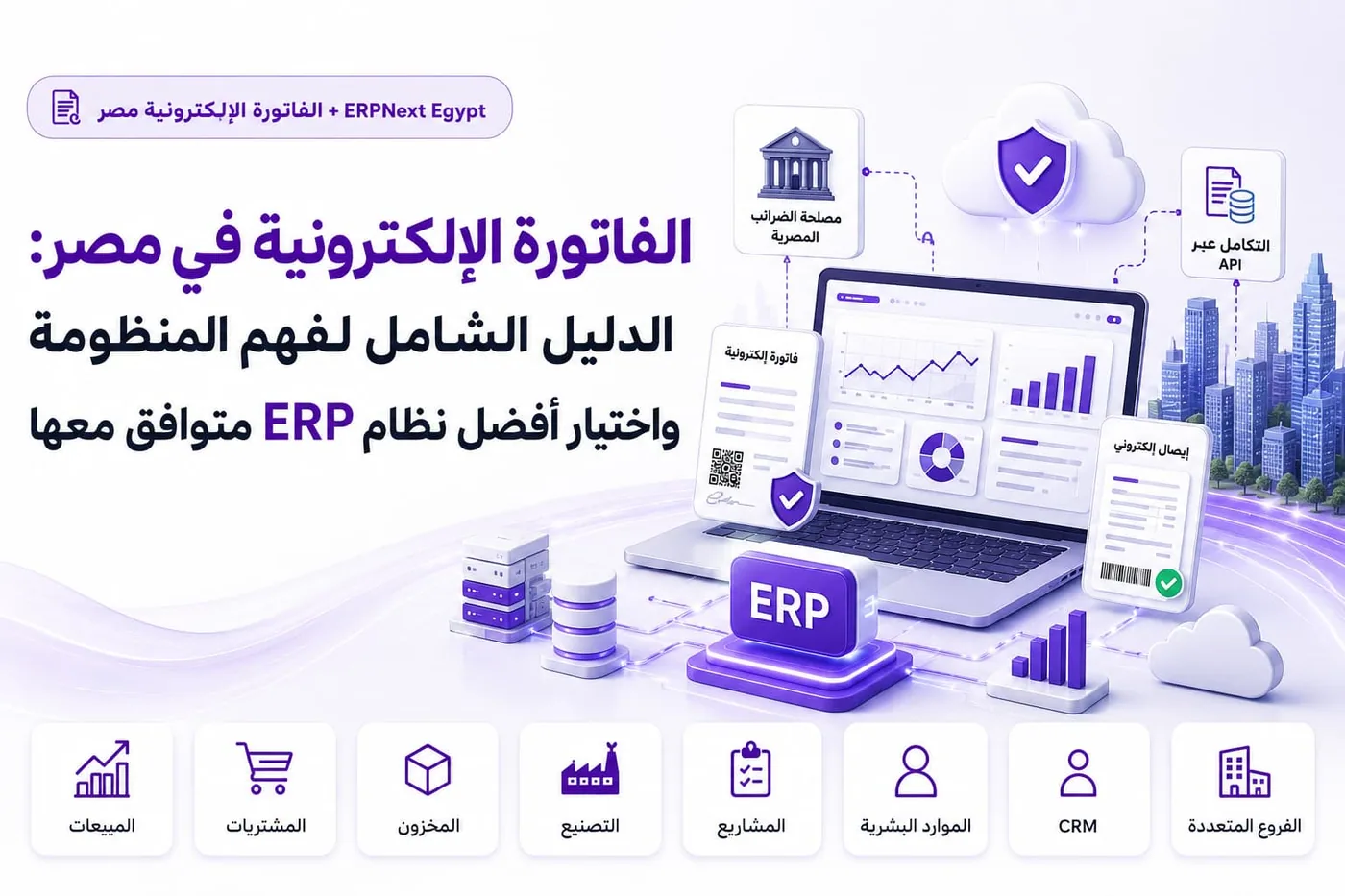
Egypt E-Invoicing + ERPNext Egypt
Whether you are looking for a complete understanding of Egypt's e-invoicing system, want to know the difference between an e-invoice and an e-receipt, or are searching for the best ERP in Egypt to help you stay tax compliant and run your business more efficiently, this guide was written for you.
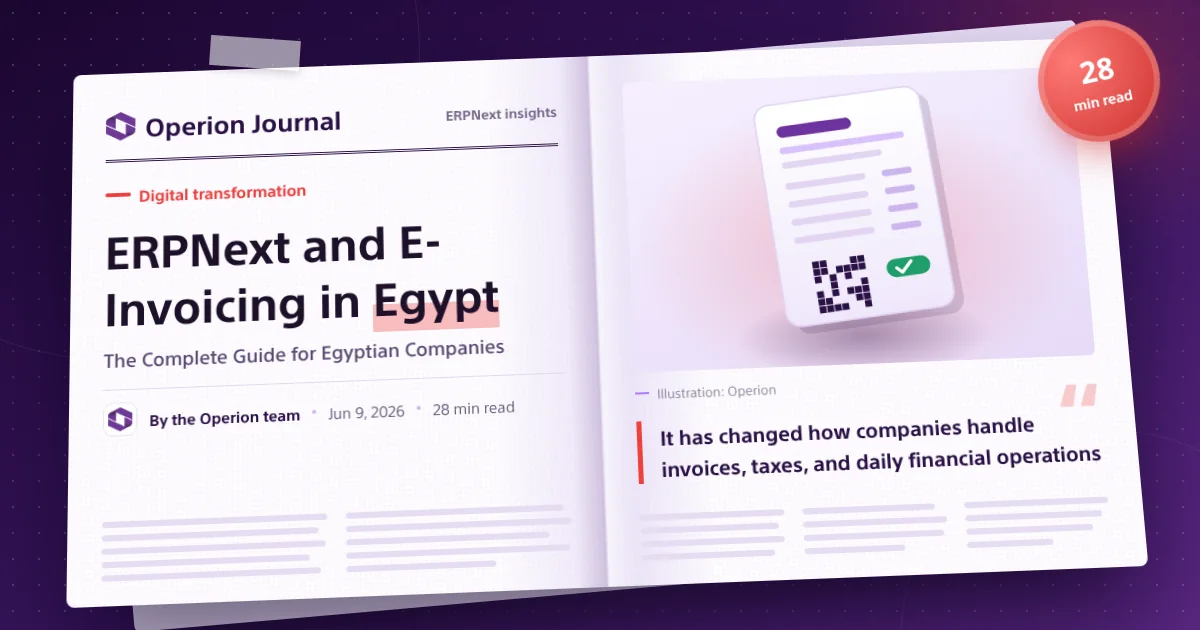
Egypt has seen rapid digital transformation in recent years across many government and economic sectors, and one of the most prominent initiatives has been the launch of Egypt's e-invoicing system, among the most important digital transformation projects led by the Egyptian Tax Authority. It has changed how companies handle invoices, taxes, and daily financial operations.
Relying on paper invoices or traditional procedures is no longer enough to run a modern business. Companies are now expected to manage customer, item, tax, and invoice data more accurately and professionally to remain fully compliant with Egypt's e-invoicing requirements and to avoid errors that can lead to rejected invoices or disrupted operations.
As Egypt's e-invoicing system expands, companies are realizing that the real challenge is not just sending the invoice to the Tax Authority, but building an integrated system that connects sales, accounting, inventory, customers, and taxes in one platform. That is why interest in modern ERP solutions has grown, and why searching for the best ERP in Egypt has become one of the most discussed topics among business owners, finance managers, and digital transformation leaders.
Manage sales, accounting, inventory, customers, and taxes from one platform.
One of the leading open-source ERP systems used in Egypt and the Gulf.
Run ERPNext on Frappe Cloud or modern cloud hosting.
Egypt's E-Invoicing System
The e-invoice journey, from creation to approval
When you hear the term e-invoicing in Egypt, you might assume the process is just creating an invoice and sending it to the Tax Authority. In reality, the invoice goes through several sequential stages to ensure data accuracy and tax compliance. The better organized your data is inside an integrated ERP like ERPNext, the faster, more accurate, and less error-prone the process becomes.
Creating the invoice
The Egyptian e-invoice journey begins inside the ERP or invoicing software the company uses. Customer, item, quantity, price, and tax data are entered in an organized way. In modern systems like ERPNext, most of the data is pulled automatically from the database, which reduces human error and keeps information consistent.
Validating the data
Before the invoice is sent, a large set of data is checked, such as the customer's tax ID, item codes, tax values, and the mandatory fields required by the Egyptian Tax Authority. This stage reduces the chance that the invoice will be rejected later.
Electronic signature
After the data is verified, an approved electronic signature is applied to the invoice. The electronic signature is an essential part of the e-invoicing system because it proves the identity of the issuer and ensures the data is intact and has not been tampered with.
Sending the invoice to the Tax Authority
The invoice data is sent electronically through approved integration interfaces to the Egyptian Tax Authority's system. Automated review then begins, checking the structure, data, and taxes before the final result is issued.
Reviewing and approving the invoice
After receiving the invoice, the Egyptian Tax Authority's system reviews the data and checks that it complies with the approved tax rules. If all checks pass, the invoice is approved and given an official accepted status. If there are errors or missing data, it is rejected with the reasons stated so the company can correct it and resubmit.
Saving the invoice and linking it to financial records
Once approved, the invoice becomes part of the company's financial and tax records. This is where it matters that the e-invoicing system is integrated with accounting, inventory, and sales inside a capable ERP, so financial accounts, tax reports, and customer balances update automatically without entering data more than once.
Why do companies need an ERP to manage e-invoicing?
As sales volume and the number of customers and invoices grow, managing e-invoicing manually becomes more complex and more error-prone. That is why companies are turning to ERP systems like ERPNext in Egypt to connect the sales cycle, accounting, inventory, and taxes in one platform. This integration speeds up invoice issuing, reduces errors, and improves compliance with Egypt's e-invoicing requirements.
Fewer errors
Relying on unified data reduces manual entry errors.
Faster issuing
Issue and send invoices in seconds instead of going through traditional procedures.
Stronger tax compliance
Make sure invoices meet the Egyptian Tax Authority's requirements.
Real-time reports
Track sales, taxes, and invoices instantly and accurately.
An e-invoice is not just an invoice. It is a complete process
Successfully implementing e-invoicing in Egypt depends not only on sending invoices to the Tax Authority, but on having an integrated ERP that manages the entire workflow, from the customer and product through collection and financial reporting. That is why solutions like ERPNext Egypt are among the top choices for companies that want to combine tax compliance with operational efficiency.
E-Invoice and E-Receipt
What is the difference between an e-invoice and an e-receipt?
The difference between an e-invoice and an e-receipt is one of the most searched questions in Egypt since digital tax systems were introduced. Although both systems fall under the Egyptian Tax Authority, each has a different purpose and a different use depending on the type of business and the customers it serves.
E-invoice
Egypt's e-invoice is typically used for transactions between companies (B2B) or between companies and corporate entities, and is sent electronically to the Egyptian Tax Authority for verification and approval.
Used between companies and organizations.
Tied to Egypt's e-invoicing system.
Requires detailed tax data.
Relies on electronic signature.
Serves business transactions between establishments.
E-receipt
Egypt's e-receipt is aimed mainly at transactions between companies and the end consumer (B2C), such as retail stores, restaurants, pharmacies, and other points of sale.
Used with the end consumer.
Tied to the e-receipt system.
Supports businesses with high daily sales volumes.
Aims to document retail transactions.
Companies, factories, and distributors
Stores, restaurants, and points of sale
Documenting consumer sales transactions
Does your company need the e-invoice or the e-receipt?
It depends on the nature of your business. If your company deals mainly with other companies or corporate entities, Egypt's e-invoicing system is likely your primary requirement. If you run a store, a chain of branches, or a retail business that deals directly with end consumers, the e-receipt system will be a core part of your daily operations. In many cases, larger companies need to run both systems inside a single ERP.
When do you need the e-invoice?
If your company works in manufacturing, distribution, contracting, or professional services, or deals continuously with other companies and organizations, implementing Egypt's e-invoicing system becomes essential for tax compliance and more efficient invoice management.
When do you need the e-receipt?
If you run a business built on direct points of sale, such as retail stores, restaurants, pharmacies, fuel stations, and other points of sale, the e-receipt in Egypt helps you document daily sales and send the data to the tax system easily.
One ERP to manage both the e-invoice and the e-receipt
Instead of using several separate systems for sales, accounting, and taxes, a modern ERP like ERPNext Egypt can manage e-invoices and e-receipts and link them to accounting, inventory, customers, and reports in one integrated platform.
It has changed how companies handle invoices, taxes, and daily financial operations
The challenges companies face before implementing an ERP
Before implementing an ERP in Egypt, many companies rely on a set of separate programs, Excel files, and manual procedures to manage sales, accounting, inventory, and HR. As the business grows in customers, branches, and employees, these methods start to create operational challenges that hurt efficiency, profitability, and decision-making.
Relying on Excel files
Many companies rely on Excel spreadsheets to manage sales, inventory, and accounts. Over time the files multiply and become complex, making it hard to control versions or know which data is correct, which leads to recurring operational errors.
Disconnected, separate systems
A company may use one program for accounting, another for inventory, a third for sales, and a fourth for HR. This separation leads to duplicate data entry and makes it hard to get a unified picture of company performance.
Tax and accounting errors
With Egypt's e-invoicing and e-receipt systems in place, accuracy of tax data has become critical. Errors in taxes or customer data can lead to rejected invoices, delayed operations, or problems during financial reviews.
Duplicate data entry
In many companies the same data is entered more than once in more than one system. This wastes time, raises the chance of errors, and slows daily operations.
Weak reporting and hard decision-making
One of the biggest problems companies face before implementing an ERP is the difficulty of getting accurate reports on time.
Time lost on routine work
When a company relies on manual procedures, employees are busy entering, reviewing, and moving data between different systems.
No unified view of the company
When data is spread across multiple departments, it is hard to know the company's true position and make the right strategic decisions.
Difficulty complying with e-invoicing
With Egypt's e-invoicing system in place, companies are required to send accurate data that meets Egyptian Tax Authority requirements.
The problem isn't too much work. It's how the work is managed
As companies grow and daily operations increase, traditional systems and Excel files can no longer keep up with modern management needs. Problems begin to show up as accounting errors, delayed reports, weak oversight, and difficulty meeting Egypt's e-invoicing requirements. That is why thousands of companies have started looking for the best ERP in Egypt that can unify all operations in one integrated platform.
Higher costs
Manual processes consume more time and resources than necessary.
Lower efficiency
Slow procedures hurt productivity and service quality.
Tax risk
Errors can lead to rejected invoices or compliance issues.
Slower decision-making
A lack of real-time data delays strategic decisions.
That is why companies turn to modern ERP systems
The real solution is not adding more files or separate programs, but building a unified platform that connects sales, accounting, inventory, customers, HR, and taxes in one system. This is where solutions like ERPNext Egypt come in, helping companies run their business more efficiently with full support for e-invoicing, e-receipts, and modern digital transformation requirements.
ERP Egypt • ERP for companies
Why do companies need an ERP system?
With growing competition, digital transformation requirements, and systems like Egypt's e-invoicing in place, relying on separate programs or manual procedures is no longer enough to run a business. That is why companies in Egypt and around the world are implementing modern ERP systems to unify operations, improve efficiency, and make decisions based on accurate data.
The term ERP, or Enterprise Resource Planning, refers to an integrated system that connects all of a company's departments in one platform. Instead of one program for accounting, another for inventory, a third for sales, and a fourth for HR, an ERP system brings all these operations into one unified database that works in a connected, synchronized way.
When a salesperson creates a new invoice, financial accounts, inventory, and profit reports are updated instantly. When a purchase, a stock issue, or a customer payment is recorded, those transactions automatically flow through to all related departments. This is the real power of modern ERP systems.
That is why ERP systems have become one of the most important technology investments for companies that want to grow, improve operational control, raise employee efficiency, reduce errors, and comply with e-invoicing and e-receipt requirements in Egypt.
A unified database
Instead of data scattered across Excel files and multiple programs, an ERP provides a central database that ensures every department works from the same accurate, up-to-date information.
Fewer errors
When data is entered only once in the system, errors from duplication and manual entry drop and data quality improves significantly.
Process automation
ERP helps automate many routine processes such as issuing invoices, managing purchasing, tracking inventory, and internal approvals, saving time and increasing productivity.
Real-time reports
Getting KPIs and profit, sales, and inventory reports in real time helps management make faster, more accurate decisions.
Better customer service
ERP provides a complete view of the customer, including sales, payments, contracts, and invoices, helping you deliver faster, more professional service.
Support for growth and expansion
As the number of branches, employees, or customers grows, an ERP system can scale with the company without changing systems or rebuilding processes from scratch.
Sales
Create quotations, orders, and invoices.
Inventory
Update quantities and item movements instantly.
Accounting
Record journal entries and financial impact automatically.
How does an ERP system connect all of a company's departments?
The real power of any ERP system lies not in managing a single department, but in its ability to connect all departments in one unified database. When a sales invoice is created, inventory, accounts, profit reports, and taxes are updated at the same moment. When new materials are purchased, items are issued, or customer payments are collected, these transactions flow automatically to the other departments without re-entering data. This connectivity is what makes an ERP system an essential tool for modern companies that value accuracy, speed, and the ability to grow.
E-invoicing
A direct link between sales, taxes, and digital compliance requirements.
Cloud-based work
Access data and reports from anywhere, at any time.
Automation
Reduce manual work and speed up the entire workflow.
Growth and expansion
Grow in branches, employees, and customers without changing systems.
Why has ERP become a necessity, not a luxury?
In the past, ERP systems were considered an advanced option for large companies only. Today they have become a necessity for every company that wants to compete and grow sustainably. With Egypt's e-invoicing in place, growing data volumes, and the need for fast, accurate decisions, it is hard to run a business on separate files or traditional programs. That is why companies in Egypt are adopting modern systems like ERPNext Egypt, which provide a unified platform for accounting, sales, inventory, HR, and taxes in one integrated, scalable environment.
ERPNext Egypt • Open Source ERP
What is ERPNext, and why is it considered one of the best ERP systems in Egypt?
When you search for the best ERP in Egypt, or an ERP compatible with Egypt's e-invoicing, you will find ERPNext appearing consistently among the most widely used options. That is because it can manage all of a company's operations through one integrated platform that combines accounting, sales, inventory, HR, project management, manufacturing, and customer service.
ERPNext is an open-source ERP developed by Frappe Technologies, and it is used today by thousands of companies worldwide to manage financial, operational, and administrative processes efficiently. The system is highly flexible and can be customized to fit the needs of small, medium, and large companies alike.
Unlike many traditional systems that require expensive licenses, ERPNext offers a more flexible, modern-technology-based model, which has made it a preferred choice for many companies in Egypt, Saudi Arabia, Kuwait, Qatar, and the UAE that want to go digital and cut operating costs.
ERPNext Egypt has also become one of the most requested solutions among companies looking for an ERP compatible with e-invoicing and e-receipts, as it can be linked with accounting, sales, and inventory to provide a unified, accurate working environment.
Open-source system
Gives companies more flexibility in customization, development, and integration, without the constraints of traditional licensing or high costs.
Compatible with e-invoicing
Helps companies manage the sales, invoicing, and tax cycle in one integrated environment that supports modern digital transformation requirements.
A unified platform
Brings accounting, sales, inventory, HR, project management, and manufacturing into one database.
Scalable
Suits startups and mid-size and large companies, and scales as the business grows and as users and branches increase.
A modern, easy interface
Offers a flexible, easy-to-learn user experience compared with many traditional ERP systems on the market.
Supports digital transformation
Helps organizations automate processes, cut paperwork, and improve operational efficiency and decision-making.
Advanced reporting
Real-time dashboards and reports help management track performance and make decisions quickly.
Cloud deployment
Run ERPNext on Frappe Cloud or any modern cloud hosting environment.
High security
Advanced permissions, a full audit trail, and strong protection for sensitive data.
Customization flexibility
Forms, workflows, and reports can be adapted to each company's needs.
Which industries use ERPNext?
One of ERPNext's greatest strengths is that it is not built for a single type of business. It can be applied across a wide range of industries, making it one of the most flexible ERP systems in the Egyptian and Arab market.
Factories
Manage production, manufacturing, raw materials, work orders, and quality control.
Contracting companies
Manage projects, progress billing, costs, subcontractors, and project profitability.
Trading and distribution
Manage inventory, purchasing, sales, branches, and sales reps.
Retail
Run points of sale and manage branches, promotions, and central inventory.
Services
Manage contracts, HR, projects, timesheets, and billing.
Education and training
Manage students, courses, fees, and administrative and financial operations.
Why does the global ERP community prefer ERPNext?
ERPNext has gained wide adoption worldwide because it combines the power of large enterprise systems with the flexibility of modern open-source systems. An active global community of developers, consultants, and certified partners also helps the system evolve continuously and add new features regularly. That is why ERPNext Egypt has become a popular choice for companies looking for an integrated ERP that supports Egypt's e-invoicing while offering flexibility in customization, scaling, and cloud hosting through Frappe Cloud, without the heavy costs of some traditional systems.
How does ERPNext manage the sales cycle and e-invoicing end to end?
One of the main reasons ERPNext is among the best ERP systems for companies in Egypt is that it does not treat e-invoicing as a separate process. It links it to the full sales cycle. Instead of creating invoices separately and then re-entering the data in accounting or inventory, ERPNext manages the entire customer journey, from the first sales opportunity through payment collection and sending the e-invoice.
Many companies use different programs to manage customers, sales, invoices, and collections, which leads to duplicate data, frequent errors, and difficulty tracking the customer journey. In ERPNext, all stages are connected in one database, which makes the system ideal for companies looking for an ERP compatible with Egypt's e-invoicing.
Lead
The sales journey starts by logging the prospect in ERPNext's CRM. All contact details, activities, and notes are saved, helping the sales team follow up on opportunities professionally.
Opportunity
When a prospect becomes a real sales opportunity, an Opportunity is created to track deal value, win probability, and the products or services requested.
Quotation
The sales team prepares the quotation directly in the system, setting prices, taxes, and payment terms, and can send the quote to the customer electronically.
Sales Order
After the customer approves, the quotation is converted to a Sales Order, which kicks off the operational work of supply, production, or order preparation.
Delivery Note
When products are delivered or the service is performed, a Delivery Note is created. At this stage, inventory is updated automatically in ERPNext, item movements are recorded, and quantities delivered to the customer are tracked. This step ensures the final invoice is based on actual deliveries rather than separate data or manual entry.
Sales Invoice
Once the sale or delivery is complete, a Sales Invoice is created. ERPNext automatically calculates taxes, discounts, and the total amount due. The accounting entries tied to the invoice are also posted in the system directly, with no extra intervention.
E-Invoice
When ERPNext is integrated with Egypt's e-invoicing system, the invoice data is sent electronically to the Egyptian Tax Authority. This is where the system's strength shows in reducing errors from re-entering data: the same sales, accounting, and inventory data is used to issue the e-invoice accurately and in line with tax requirements.
Payment
After the invoice is approved, payments and collections can be recorded in ERPNext and linked directly to the invoice, the customer, and the financial accounts. The entire sales cycle is completed in one platform, from prospect through collecting the money and closing the accounting process.
Unified data
Enter data only once in the system.
Greater speed
Speed up the whole sales and collection cycle.
Tax compliance
Better integration with Egypt's e-invoicing requirements.
Instant reports
Real-time visibility into sales, profits, and collections.
ERPNext doesn't just manage the invoice. It manages the whole customer journey
The real difference between ERPNext and traditional invoicing software is that the system doesn't start when the invoice is issued or end when payment is collected. It manages the entire customer journey, from the first contact with a prospect through closing the deal and analyzing profitability. That is what makes ERPNext Egypt one of the strongest solutions for companies looking for an ERP compatible with Egypt's e-invoicing that can support growth and future expansion.
From sales to e-invoicing in one platform
When all departments work in a unified system, data becomes more accurate, reports become more reliable, and operational and tax errors drop significantly. That is why modern companies rely on ERPNext to manage sales, accounting, inventory, and e-invoicing through one integrated platform that supports real digital transformation.
ERPNext + E-Invoicing Egypt
Benefits of ERPNext with Egypt's e-invoicing
Many companies are looking for an ERP compatible with Egypt's e-invoicing, but the more important question is: what is the real benefit of integrating an ERP with the e-invoicing system? Simply put, integrating ERPNext with e-invoicing is not just about sending invoices to the Tax Authority. It extends to improving the company's entire financial and operational processes.
When e-invoicing runs separately from the finance or sales system, companies have to re-enter and re-check data more than once. With ERPNext Egypt, all the data the invoice requires is already in the system and is used automatically to create and send e-invoices.
This integration helps reduce errors, improve tax compliance, and speed up the entire workflow, while giving management an accurate, real-time view of sales, taxes, and collections.
Fewer human errors
The same data already in ERPNext is used to create e-invoices, reducing errors from manual entry or moving data between different systems.
Better tax compliance
The system helps you meet Egypt's e-invoicing requirements and lowers the chance of invoices being rejected because of missing data or tax errors.
Faster invoicing
Invoices can be created and sent very quickly because all the required information is already available in the unified database.
Real-time financial reports
Get instant visibility into sales volume, taxes, collections, and outstanding balances without preparing manual reports.
Connected departments
Sales, accounting, inventory, customers, and e-invoices are linked in one platform with no need for separate programs.
Higher employee productivity
Cut routine work and save the time lost entering and re-checking data more than once.
ERPNext and e-invoicing: from tax compliance to profitability
Many companies start their digital transformation journey to comply with Egypt's e-invoicing requirements, but later discover the real benefit goes far beyond sending invoices to the Tax Authority. When ERPNext is implemented correctly, it becomes an integrated platform that improves operational efficiency, reduces costs, increases profitability, and improves the customer experience.
Increased productivity
Reduce the time spent on manual work and repetitive procedures.
Higher profitability
Get an accurate view of costs, profit margins, and performance indicators.
Reduced risk
Lower the chance of operational, tax, and accounting errors.
Better customer service
Quick access to customer, invoice, and payment data.
Why is ERPNext a competitive advantage for modern companies?
In today's business environment, having invoicing software is no longer enough. Successful companies need an integrated ERP that connects all departments and provides a unified view of data. This is where ERPNext Egypt shows its strength, combining accounting, sales, inventory, customer management, HR, and e-invoicing in one platform.
Turn data into measurable performance indicators.
Manage sales and accounting from one system.
Support expansion into new branches and future activities.
Full integration with digital transformation requirements.
Cloud hosting support through Frappe Cloud.
High flexibility in customization and development.
ERPNext is not just e-invoicing software
If your goal is to find the best ERP in Egypt that is compatible with Egypt's e-invoicing, ERPNext offers more than tax compliance. It provides an integrated platform for managing financial and operational processes, analyzing performance, improving productivity, and supporting future growth. That is why ERPNext Egypt has become one of the most widely adopted solutions among companies seeking real digital transformation, not just a tool for issuing invoices.
What is the best ERP compatible with e-invoicing in Egypt?
This is one of the questions companies ask most after adopting Egypt's e-invoicing and e-receipt systems. With tax compliance requirements and digital transformation increasing, the goal is no longer just to issue an e-invoice, but to choose an integrated ERP that can manage sales, accounting, inventory, customers, and taxes through one platform.
When you search for the best ERP in Egypt, you will find many options such as ERPNext, Odoo, Microsoft Dynamics 365, SAP Business One, and others. But the real comparison should not rest only on a system's name or reputation, but on how well it fits your company's current and future needs.
Smart companies don't only ask, "Does the system support e-invoicing?" They also ask, "Will the system help me improve operations? Can it scale with the company? Is the operating cost reasonable? Can it be customized easily? And is there a strong implementation partner I can rely on?"
That is why you should look at a set of core criteria before deciding which ERP to choose for your company.
Tax compliance
The system's ability to support e-invoicing, e-receipts, and compliance with local regulations.
Ease of use
How easy the system is to learn and use for employees and different departments.
Scalability
The ability of the system to grow as branches, users, and operations increase.
Return on investment
The balance between implementation and operating cost and the benefits the system delivers to the company.
Compatible with e-invoicing
Suitable for small and medium-sized companies
Is ERPNext better than Odoo, SAP, or Dynamics?
No single ERP is the best for every company. The right choice depends on company size, the nature of the business, budget, and future growth plans. But for many companies in Egypt looking for an ERP compatible with Egypt's e-invoicing that combines flexibility, a fair cost, and ease of customization, ERPNext is among the strongest options available today.
Why ERPNext?
It offers a strong mix of flexibility, fair cost, and openness to customization and development, with an active global community and strong cloud hosting support through Frappe Cloud.
When are SAP or Dynamics a good fit?
They are often preferred by very large enterprises with complex corporate requirements, large budgets, and broad organizational structures.
What about Odoo?
Odoo is a good option for many companies, but the final comparison depends on customization requirements, long-term cost, and the nature of operations inside the organization.
The right decision starts with your company's needs, not a system's name
When choosing an ERP in Egypt, focus on how well the system supports daily operations, e-invoicing, future growth, and a real return on investment. That is why many companies are turning to ERPNext Egypt as an integrated system that combines accounting, sales, inventory, HR, and taxes in one flexible, scalable platform.
ERP Implementation Partner
How do you choose the right ERP implementation partner for your company?
The success of an ERP project depends not only on how powerful the system is, but to a large degree on choosing the right implementation partner. Even the best ERP systems in the world can fail if implemented the wrong way, while a strong system like ERPNext can deliver exceptional results when applied by a team with the right experience and methodology.
Some companies think choosing the ERP system is the most important decision, but in reality choosing the implementation partner is just as important. The implementation partner is responsible for analyzing current processes, designing the right solution, migrating data, training users, and ensuring the project succeeds after launch.
That is why the decision to choose an ERP partner should not rest on price or the financial offer alone, but on experience, methodology, and the ability to provide long-term support and development.
Hands-on experience
Look for a partner with real, successful ERP projects in industries similar to yours, not just technical knowledge of the system.
Business analysis
A professional partner doesn't start by customizing right away. They start by understanding current processes, identifying gaps, and improving procedures.
A multidisciplinary team
The best ERP projects are delivered by a team that combines consultants, developers, trainers, and technical support experts.
E-invoicing support
The partner should have experience implementing Egypt's e-invoicing and e-receipts and tax compliance requirements.
Training and knowledge transfer
Project success depends on users being able to use the system effectively, not just on running it technically.
Long-term support
Choose a partner who can provide support, updates, and future development after the project launches, not just during implementation.
Red flags to watch for before signing
Some ERP projects fail not because of the system, but because of an unsuitable implementation partner. So it is important to watch for signs that may point to future project risk.
Focusing on price only
If the whole proposal is built around offering the lowest price without discussing processes, requirements, or an implementation plan, that is a sign to be cautious. Successful ERP projects depend on experience and methodology more than on price.
No clear methodology
A professional partner has clear phases that cover business analysis, design, implementation, training, and support. Ad hoc implementation often leads to project delays and higher costs.
Unrealistic promises
If someone promises a full ERP project in a few days, or without involvement from your internal team, those promises are probably far from practical reality.
No post-launch support
Launching the system is not the end of the project. You will need ongoing support, training, updates, and improvements to get the most from your investment.
Checklist for choosing a professional ERP partner
Has successful ERP projects you can review.
Understands your business and your industry's needs.
Has experience with ERPNext and Egypt's e-invoicing.
Provides training and knowledge transfer for users.
Has a complete consulting and technical team.
Offers post-launch support and development services.
Has a clear project management methodology.
Can help with hosting and Frappe Cloud.
Choosing the right partner may matter more than choosing the system itself
The difference between a successful ERP project and a struggling one is often not the system, but the team leading the implementation. So choose a partner with the experience, methodology, and support needed to reach your project goals and turn ERP from just software into a real tool for growth and digital transformation.
Why choose Operion to implement ERPNext in Egypt?
If choosing an ERP is an important step, choosing the right implementation partner is what decides whether the project succeeds or fails. That is why companies look for a partner who has not only technical knowledge, but also hands-on experience and the ability to understand processes and turn them into an effective system that supports growth and digital transformation.
Operion is not just an ERPNext implementation company
At Operion, we see ERPNext as a complete digital transformation project, not just installing software or setting up a few forms. We help companies redesign processes, improve performance, and connect different departments in one unified platform that supports sales, accounting, inventory, HR, manufacturing, projects, and Egypt's e-invoicing. That is why Operion has become one of the companies specializing in ERPNext implementation in Egypt and the Arab region.
Real hands-on experience
Broad experience implementing ERPNext for companies in manufacturing, contracting, distribution, services, education, and retail.
E-invoicing expertise
A full understanding of Egypt's e-invoicing and e-receipt requirements, integration mechanisms, and tax compliance.
Hosting and Frappe Cloud
Helping customers choose the best operating environment, whether Frappe Cloud, private hosting, or other cloud environments.
Training and knowledge transfer
Practical training programs that help teams get the most from the system and ensure long-term implementation success.
Ongoing support
Continuous technical support, development, and improvement services to keep the system stable and keep pace with business growth.
A clear implementation methodology
From business analysis through go-live, training, and support, in clear phases that reduce risk and increase the chances of project success.
Implementing and customizing ERP systems for industrial, trading, and service companies.
Connecting sales, customer service, and operations in one unified platform.
Support for Frappe Cloud and modern cloud solutions for companies.
Ongoing follow-up, development, and improvement to ensure project success.
What does Operion offer its customers?
Operion's services go beyond ERPNext implementation. They cover the entire digital transformation journey, from business analysis and choosing the right infrastructure to training, support, and continuous development.
ERPNext implementation
Process analysis, system setup, customization, data migration, testing, and go-live.
Integration support and compliance with Egypt's e-invoicing and e-receipt requirements.
Frappe Cloud
Choosing and setting up the ideal hosting environment and optimizing performance, security, and stability.
Training and consulting
Preparing teams and management to get the most from the system.
Development and customization
Building custom solutions that fit the needs of each company and industry.
Technical support
Ongoing support, maintenance, and improvement services after launch.
Smart Academy
If you want to learn ERPNext or build your professional skills in ERP, consulting, and digital transformation, you can benefit from the training programs and specialized courses at Smart Academy.
Knowledge Library
Explore a large collection of guides, articles, and knowledge books on ERPNext, digital transformation, and business management to help you make better decisions.
Looking for the best ERP compatible with e-invoicing in Egypt?
Whether you are planning to implement ERPNext for the first time or want to upgrade your current environment and connect it to Egypt's e-invoicing and Frappe Cloud, the Operion team can help you choose the right solution and implement it following global best practices.
Frequently asked questions about ERPNext and e-invoicing in Egypt
Below are the questions companies ask most when looking for the best ERP compatible with Egypt's e-invoicing and e-receipts, along with questions about implementing ERPNext in Egypt, hosting, training, and technical support.
Does ERPNext support Egypt's e-invoicing?
Yes. ERPNext can be integrated with Egypt's e-invoicing system so that invoices are created and sent based on the sales data already in the system, which reduces errors and improves tax compliance.
Is ERPNext suitable for small and medium-sized businesses?
Yes. ERPNext is one of the best options for small and medium-sized businesses thanks to its flexibility, fair cost, and ability to scale with the business without having to change systems later.
What is the difference between ERPNext and traditional accounting software?
Accounting software usually focuses on financial operations only, while ERPNext connects accounting with sales, inventory, HR, projects, manufacturing, and customer management in one integrated platform.
Can ERPNext run in the cloud?
Yes. ERPNext can run on Frappe Cloud or any suitable cloud hosting environment, providing easy access, security, backups, and room to scale.
How long does it take to implement ERPNext?
It varies with company size, the number of departments, and the level of customization, but most projects range from several weeks to several months depending on scope.
Does ERPNext support inventory, sales, and accounting?
Yes. ERPNext provides an integrated set of modules including accounting, inventory, sales, purchasing, CRM, HR, manufacturing, and projects.
Is ERPNext better than Odoo?
It depends on the company's needs. ERPNext is a fully open-source ERP with high customization flexibility and a fair operating cost, while Odoo is widely adopted and has a large number of apps. The right choice depends on the nature of the business, scaling requirements, budget, and digital transformation plan.
How much does it cost to implement ERPNext in Egypt?
ERPNext cost varies with the number of users, the modules required, the level of customization, and the integrations needed, such as e-invoicing or third-party systems. The cost is therefore set after carefully studying the company's needs and the project scope.
Can ERPNext run on Frappe Cloud?
Yes. Frappe Cloud is one of the best ERPNext hosting platforms worldwide, offering a specialized environment that supports easy updates, backups, high security, and management of multiple sites from a single dashboard.
Can employees be trained on ERPNext?
Absolutely. Training is one of the most important factors in ERP project success. That is why Operion offers training programs for users and different departments, and you can also benefit from specialized courses at Smart Academy to build professional skills in ERPNext, consulting, and digital transformation.
Is ERPNext suitable for factories and contracting companies?
Yes. ERPNext supports a wide range of industries such as manufacturing, contracting, distribution, trading, services, education, and retail. The system can also be customized to fit each industry's needs precisely.
Does Operion offer support and development services after launch?
Yes. Operion provides technical support, development, and continuous improvement after the project launches, as well as help with updates, performance management, hosting, and keeping operations running as smoothly as possible.
Ready to move to an ERP compatible with Egypt's e-invoicing?
Whether you are looking for the best ERP in Egypt, want to implement ERPNext and connect it to e-invoicing and e-receipts, or need professional hosting through Frappe Cloud, the Operion team is ready to help at every step of your digital transformation journey.